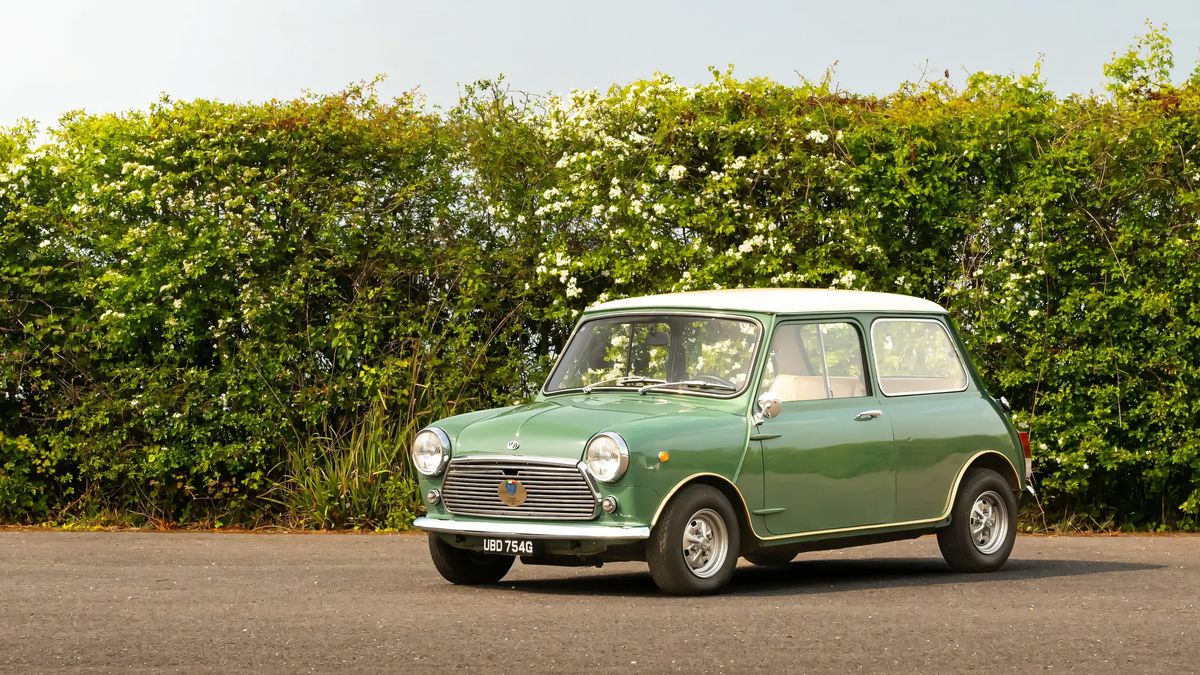
1969 Innocenti Mini Cooper MkII 1000
When Sir Leonard Lord announced on the sixth of August 1959 that Innocenti of Milan would build British Motor Corporation cars for the Italian market, he listed the Austin A40, the A55, and the Morris Oxford. He said nothing about the Mini - because as of that morning, the world didn't yet know the Mini existed. The car wouldn't be officially unveiled for another three weeks. And yet, the Italian chapter of the Mini's story had already been written before the first page was turned. That peculiar inversion of sequence - Italy contracted before Britain had even introduced the car - turns out to be entirely fitting for a machine that would, in Italian hands, become something at once deeply faithful to the original and unmistakably its own thing.
It took until March 1966 for the Mini to actually reach Italian showrooms under the Innocenti badge, the first cars arriving as CKD - completely knocked-down - kits to be assembled at the company's Lambrate plant on the outskirts of Milan. This was not unusual for the era; import tariffs in Italy were punishing enough that building locally was the only commercially sensible path. What was unusual was the company doing the assembling. Ferdinando Innocenti had built his fortune manufacturing scaffolding tubing in the 1930s, then pivoted brilliantly into transportation with the Lambretta scooter in 1946, giving postwar Italy a machine as emblematic of its recovery as the Vespa. By the time he shook hands with BMC, Innocenti's factory in Lambrate was already stamping body panels for Fiat, Alfa Romeo, and Volkswagen. These were not amateurs bolting cars together in a shed. These were skilled industrialists with metal in their blood.
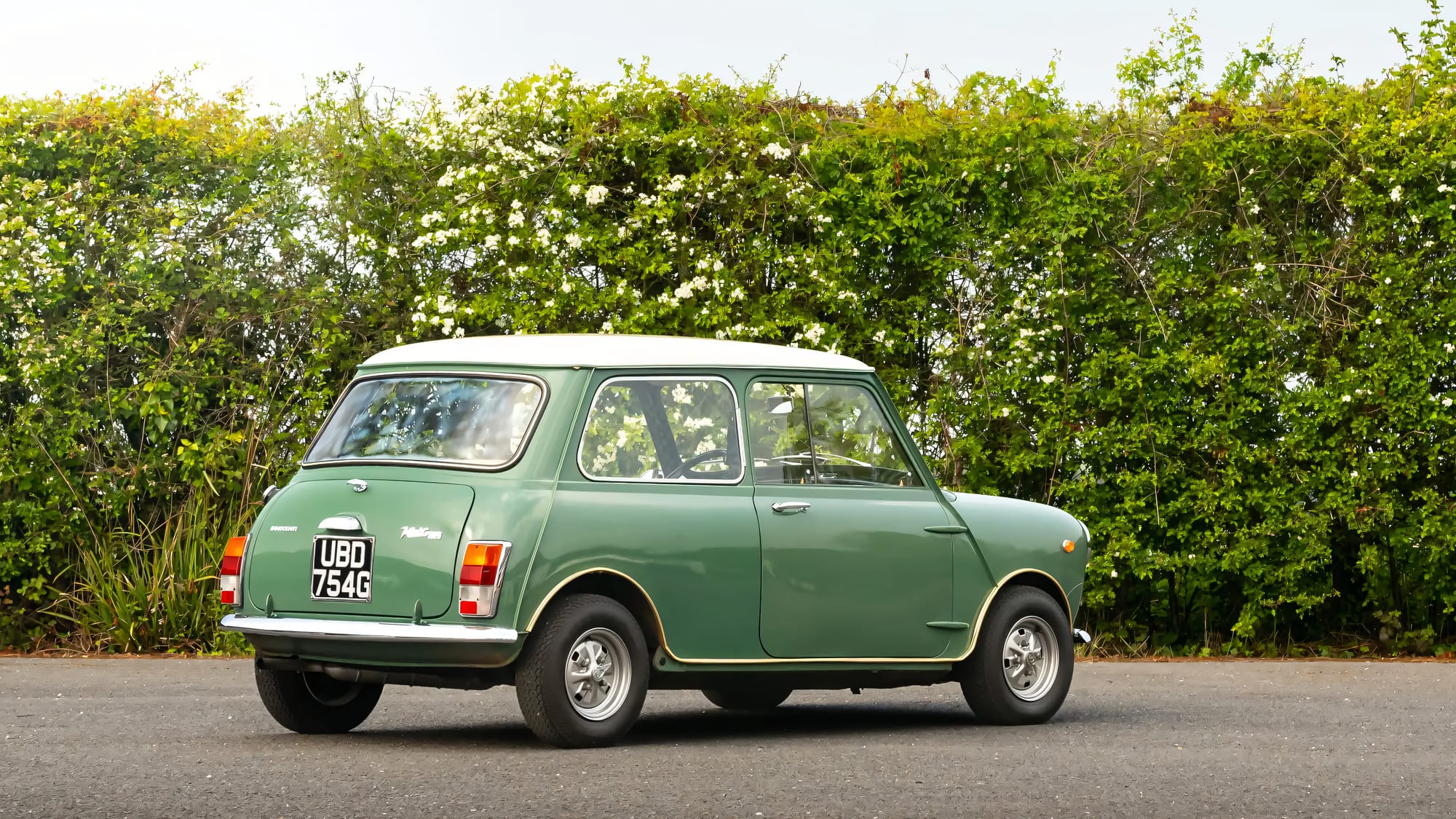
The Innocenti Mini range began with the 850, the Traveller variant, and the Cooper, and it was the Cooper that carried the glamour. The MkII Cooper 1000 arrived in September 1968 and ran until February 1970, sitting at the performance end of the Innocenti lineup and positioned in Italy as a spirited, sporting alternative to the domestic Fiat 500 and Fiat 850 Sport. Italy already had small, clever cars of its own making; selling an imported-by-proxy British one required something more than mere economy. The Cooper badge, already laden with motorsport credibility from John Cooper's exploits and Paddy Hopkirk's Monte Carlo victories, provided exactly the right currency. Italians understood sporting pedigree. Innocenti gave them a car wearing it on its nose.
The engineering heart of the MkII 1000 is BMC's A-series: a 998cc overhead-valve four-cylinder unit producing around 59 horsepower in SAE trim, with 84 Newton-metres of torque and a four-speed manual gearbox mounted in the sump in the characteristically compact Mini arrangement. The transverse engine, front-wheel-drive layout - Alec Issigonis's fundamental act of packaging brilliance - gave the car its legendary go-kart stance, with the driver sitting over the driven wheels, the mass concentrated centrally, and the handling responses arriving with an immediacy that larger, rear-driven cars simply couldn't replicate. On paper, 59 horsepower in a car weighing considerably under 700 kilograms is a modest number, but the Mini has always been a car that makes arithmetic look foolish. The real story is what that power feels like when there's almost nothing to move.
What separates the Innocenti MkII from its British-built counterparts of the same period - and it is a genuine, tangible separation - is the suspension. The MkII Cooper 1000 ran Alex Moulton's Hydrolastic system throughout its entire production life. This interconnected hydraulic setup, with fluid-filled displacer units linked front to rear so that a front wheel's compression partially lifted the rear, was BMC's answer to the age-old ride-versus-handling compromise. On smooth tarmac it worked beautifully, offering a suppleness the rubber-cone cars couldn't match while maintaining composure in corners through the interconnection's natural pitch resistance. The significance here is timing: in September 1969, Cowley switched the standard UK Mini back to dry rubber-cone suspension, partly for cost reasons and partly because the Hydrolastic system, while effective, was complex and its displacer units notoriously difficult to maintain. Innocenti kept it. The MkII Coopers assembled in Milan through to February 1970 rolled out with fluid-filled displacers intact, meaning Italian buyers were getting a more sophisticated - if more temperamental - chassis than their British counterparts were receiving by that point. It was the kind of detail that enthusiasts noted quietly and appreciated loudly.
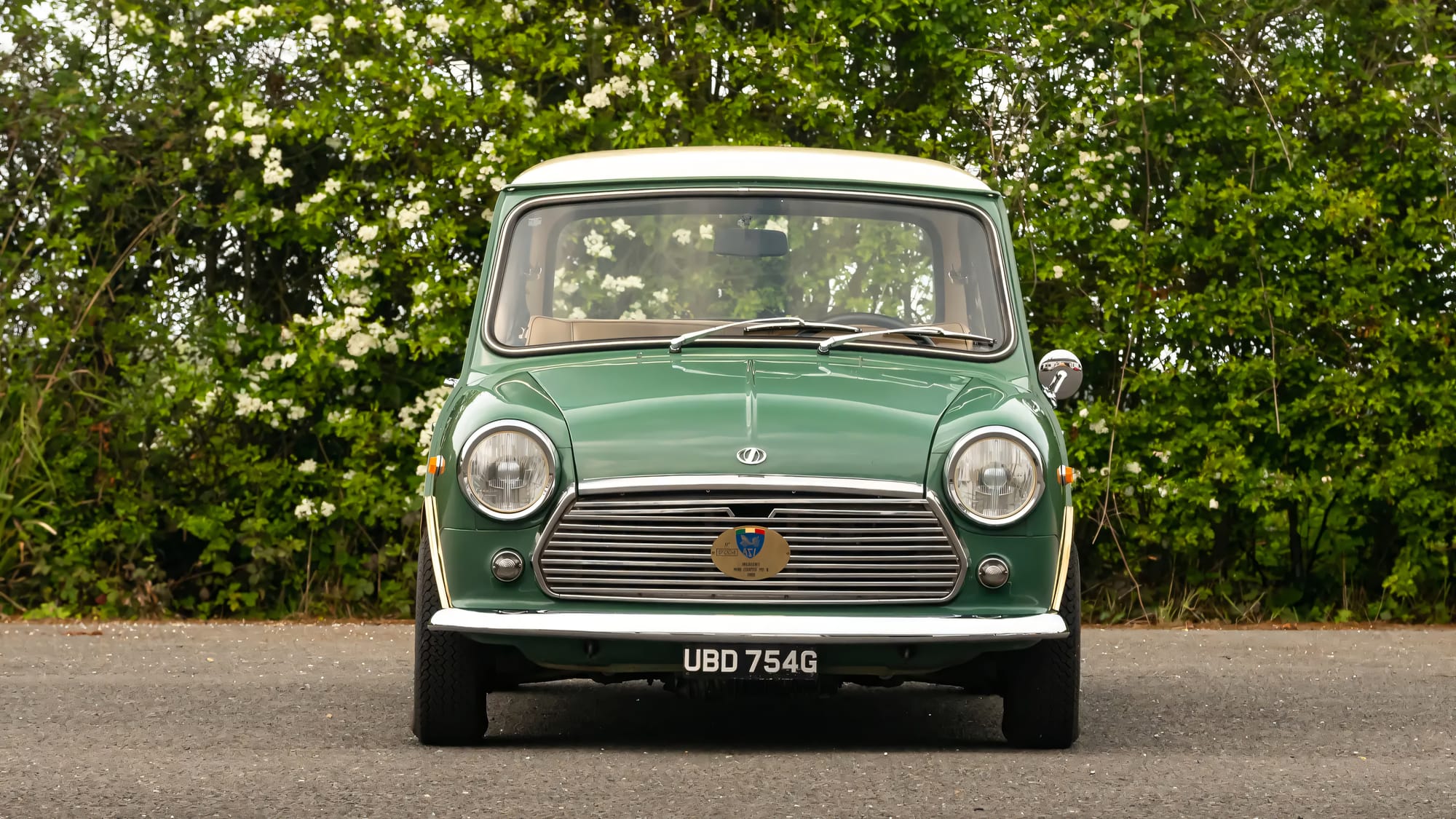
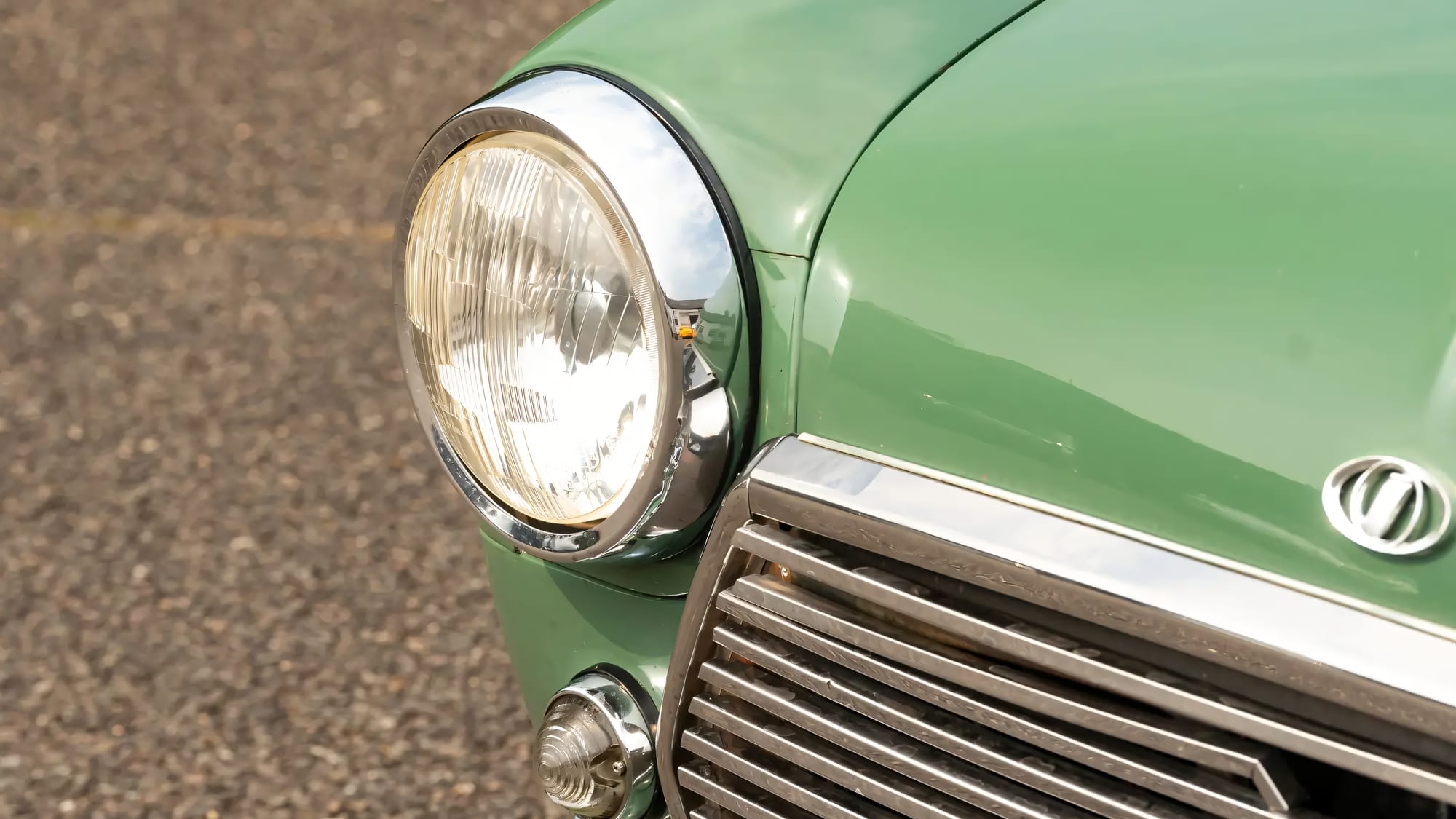
Innocenti didn't leave the exterior unchanged, and here the car's Italian character becomes visible rather than merely technical. The standard Mini's sealed-beam headlamps were replaced with Carello units behind chrome bezels - a simple substitution that somehow managed to make the face look more purposeful. The grille carried different detailing, the badging was obviously Innocenti's own, and the overall effect was of a car that respected its British origins without being slavishly deferential to them. The Verde Medio finish - a medium green that sits somewhere between British Racing Green and something more Mediterranean - suited the car's proportions particularly well, and it remains a defining colour for the model in the minds of those who know it.
Driving the MkII 1000 is an exercise in sensory recalibration. Wind-down windows were not standard on MkII-era cars, and the engine is close - very close - and loud in the way that small four-cylinders of the period inevitably were. The gearchange is short-throw and satisfying, but the remote linkage introduces a degree of vagueness that rewards commitment rather than hesitation; you push the lever where you want it to go and trust. The Hydrolastic suspension, particularly on Italian roads where it spent its working life, lends the car a floating quality at low speed that the rubber-cone variants don't replicate, but the tradeoff emerges on broken surfaces, where the interconnection can produce a gentle pitching motion that occasionally reminds you this is a 1960s hydraulic system doing its best. The steering is direct and unassisted, loading up as you'd expect, and the front-wheel-drive understeer that governs all Minis in extremis is present - but you have to work hard to find it, because the default handling mode is one of genuine, accessible delight.
The legitimate weaknesses of the MkII 1000 are well-documented. Factory records for Innocenti-built Minis are notoriously incomplete - production data from the Lambrate plant was never systematically preserved in the way that Cowley's records were, leaving provenance and specification confirmation dependent on physical evidence rather than archival certainty. The Hydrolastic system, so appealing in theory, is the car's principal ongoing liability: the displacer units are no longer in production, sourcing competent rebuilders requires specialist knowledge, and many MkII Coopers were converted to rubber cones in period precisely because maintaining the Hydrolastic system as it aged proved too demanding for ordinary ownership. A car that retains its original suspension intact is genuinely rarer than the production numbers alone would suggest. The 998cc engine, for all its charm, is also a unit that demands careful maintenance; the timing chain, oil system, and cooling arrangements all have their period-correct foibles, and anyone who treats the A-series as merely adequate rather than mechanically characterful is in for a longer relationship with its tolerances than they anticipated.
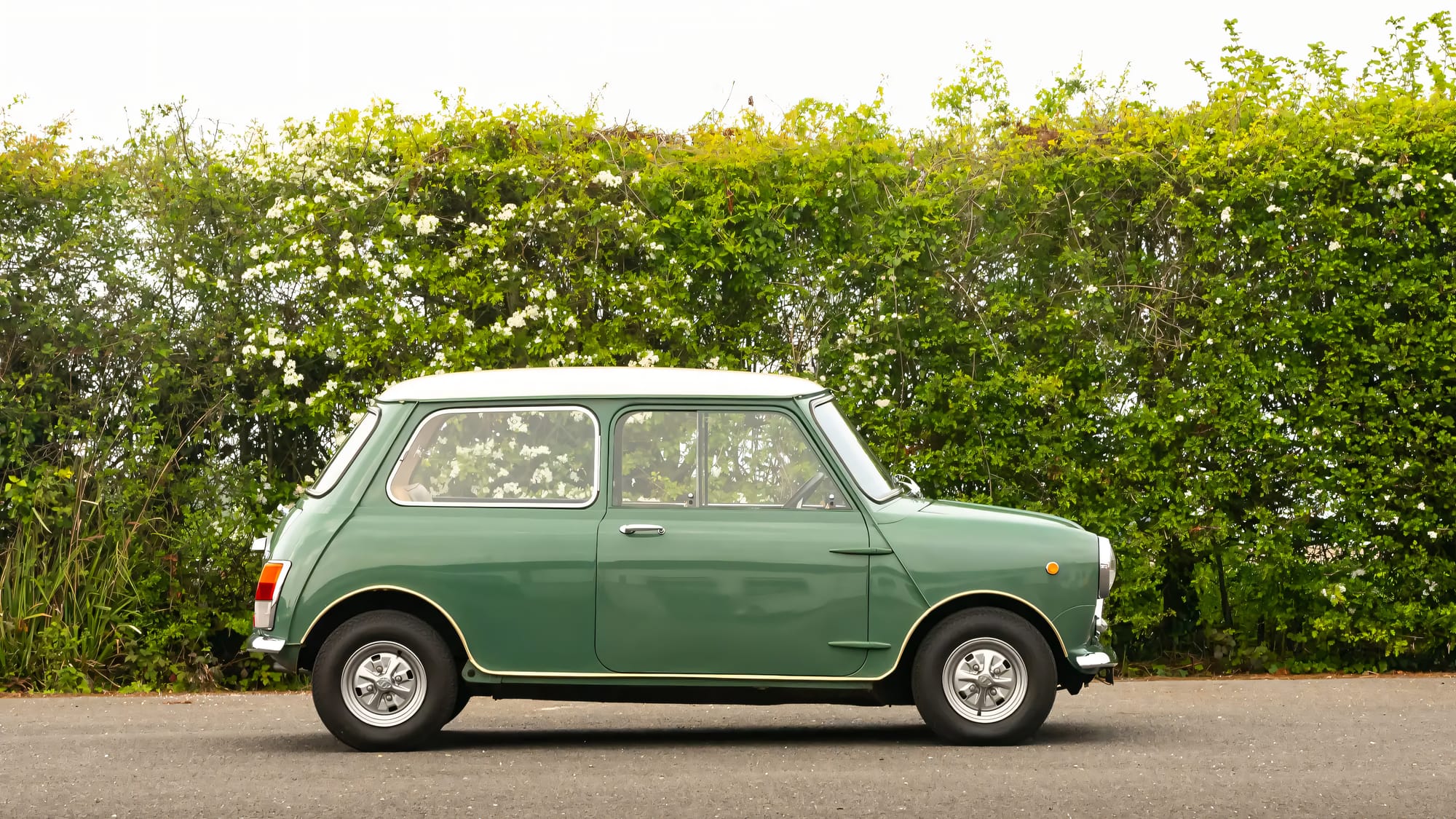
The cultural weight attached to the Innocenti Mini Cooper MkII 1000 is real but operates in a specific register. In 1969 - the precise production window of the MkII - Michael Caine drove a trio of British-built Mini Coopers through the streets of Turin in The Italian Job, cementing the car in cinematic mythology with one of cinema's most celebrated chase sequences. The irony that the most famous Minis in Italian streets were British-built, while Innocenti was simultaneously producing Italian-built Coopers a few hundred kilometres to the north in Milan, has not gone unnoticed by enthusiasts. The Innocenti version occupies the side of that story that the film didn't tell: not the flag-waving British heist narrative, but the quieter, more intimate story of a car that had genuinely become Italian by the time it reached the buyer - assembled by Italian workers, specified for Italian roads, sold by Italian dealers, and driven through Italian towns with an Italian number plate on its nose.
The motoring press of the period responded warmly to the Cooper's performance credentials, and Italian road testers noted the Hydrolastic suspension's advantages on the smooth autoroutes of the north while acknowledging that urban Italian cobblestones occasionally revealed its limitations. The consensus was that the Innocenti Cooper offered more for the money than the domestic competition at the sporting end of the small car market - a credible, well-engineered machine rather than a novelty import. Collector and specialist reception in the decades since has become considerably more passionate, as the relative rarity of surviving MkII Coopers in good, original condition has made them genuinely sought-after objects. Production of just 8,992 units across a seventeen-month run was modest by any standard, and the attrition rate of small cars driven on Italian roads through the 1970s and beyond was, predictably, severe.
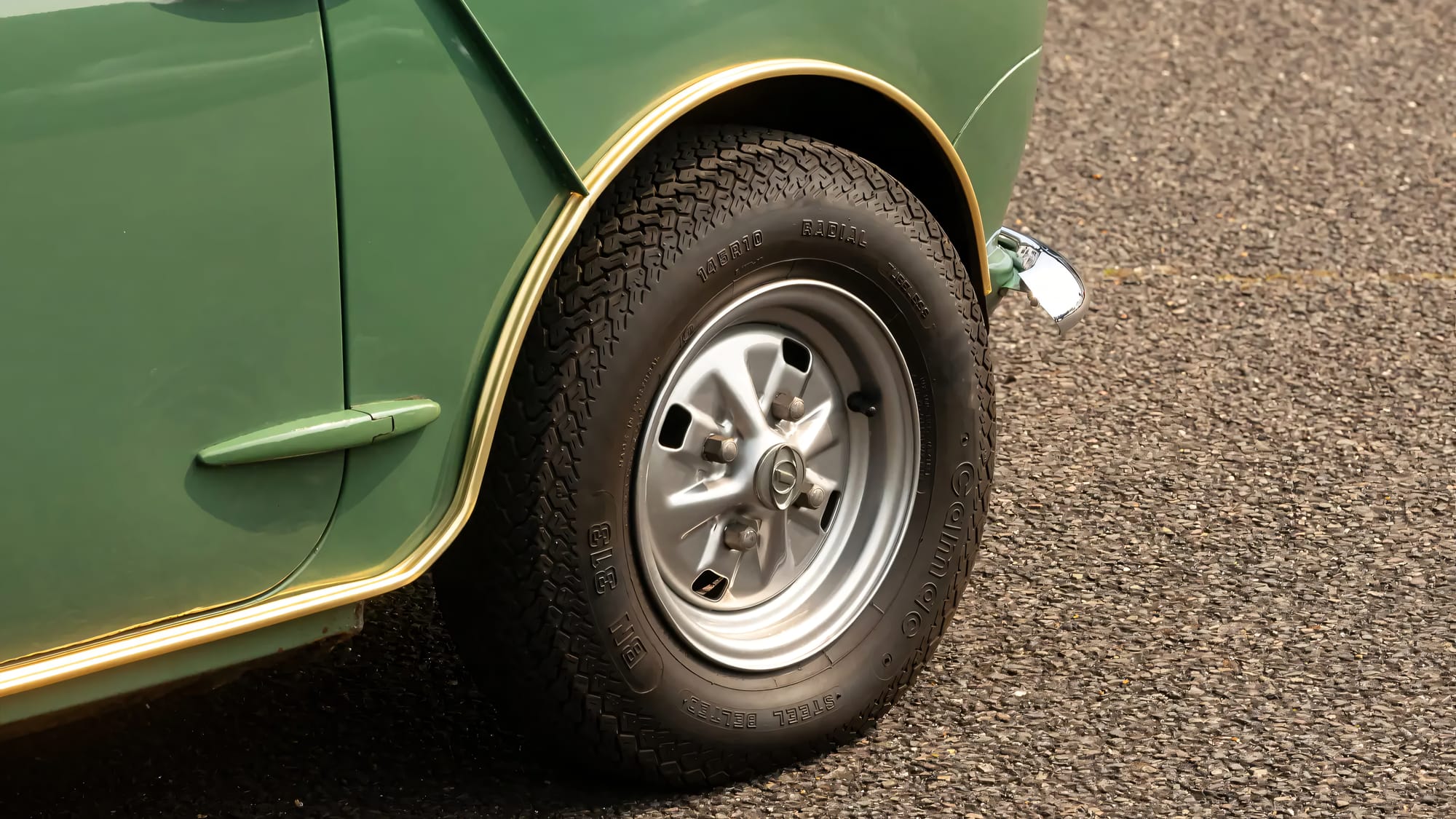
What makes the MkII Cooper 1000 worth understanding, fifty-odd years on, is the precision of what it was. It wasn't the most powerful car BMC was making, and it wasn't the most sophisticated vehicle that Innocenti's factory could produce. It was, instead, a car built at the exact intersection of two particular industrial competencies - one British, one Italian - during the brief window in which both organisations were doing their best work together, before British Leyland's corporate upheavals of the early 1970s changed the dynamic permanently. Innocenti would continue building Minis until 1975, including the celebrated Cooper 1300 Export that became something of a cult object in its own right. But the MkII 1000 sits in the middle of the collaboration's golden years, old enough to carry the Hydrolastic system and the chrome-bezel headlamps, young enough to still be a Cooper in the full sense of the word. That specificity is not nothing. For a car that was always defined by what it packed into a small space, it turns out to be everything.