Small Sporting Cars of the 1960s
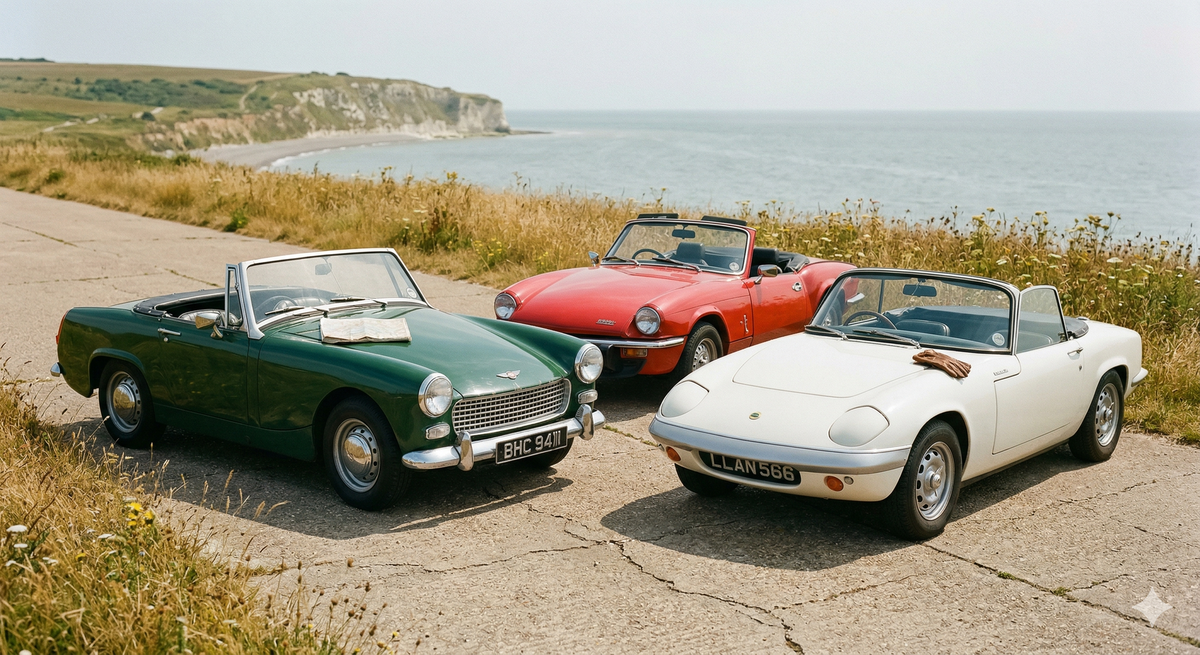
The sports car of the 1960s was not born from ambition - it was born from a specific argument about what a car needed to weigh, and the decade's finest small machines were built by people who had answered that question more radically than anyone expected.
The argument had British origins but no single nationality. Colin Chapman's "simplify, then add lightness" philosophy arrived at the Lotus Elan in 1962 as a backbone steel chassis clothed in a fibreglass body, weighing under 700 kilograms and powered by a Ford Kent block fitted with a Lotus-developed twin-cam head. At roughly the same moment, Donald Healey's Austin-Healey Sprite had already demonstrated - from 1958 onward - that a sports car built on A35 running gear, with quarter-elliptic springs and a rack-and-pinion borrowed from the Morris Minor, could deliver genuine driving engagement at a price working people could consider. And in Turin, Alfa Romeo's Giulia Sprint GT arrived in 1963 with a twin-cam 1,570cc engine, a Giugiaro-influenced Bertone body, and a driving character so composed and balanced that road testers reached for the word "complete" in a way they rarely used for anything south of Ferrari money. These were not three versions of the same thing - they were three different answers to the same question, made by engineers who did not agree with each other.
The Elan defined the apex. Gordon Murray, years later designing the McLaren F1, reportedly said his only disappointment with that car was that he could not replicate the Elan's steering - a remark that says more about what Chapman achieved than any lap time. The twin-cam engine, independent suspension at all four corners, and that featherweight body produced a machine that embarrassed cars of twice its price in almost every dynamic category bar straight-line speed above 90 mph, where the Elan's modest 105 bhp Sprint version ran out of breath. It was Lotus's first genuine commercial success and financed much of the racing programme that followed.
The Sprite and its twin the MG Midget operated in a different register - cheaper, cruder, and in some specifications frankly underpowered - but they delivered something the Elan never could: accessibility without compromise of the essential experience. In 1962, a new Midget cost £613 against the Elan's £1,499; the Spitfire sat in between at £730. The hierarchy was clear, the gradient almost perfectly calibrated. A buyer entering at Midget level could feel the same wind and the same mechanical directness as the Elan driver, even if the handling precision and outright performance were materially different.
The Triumph Spitfire deserves its own chapter in this story. Built on a modified Herald platform with a swing-axle rear suspension that generated genuinely dangerous oversteer at the limits - a tuck-under characteristic that claimed enough accidents to become notorious - the Spitfire nonetheless sold in vast numbers because the styling by Giovanni Michelotti was simply beautiful and the price was right. It represented the decade's defining compromise: aesthetic excellence purchased at the cost of dynamic safety, which bothered some journalists considerably and most buyers not at all.
Italy's contribution beyond Alfa went largely unrecognised in Britain at the time. The Fiat 850 Spider, designed by Bertone and launched in 1965 with a 47 bhp rear-mounted engine, offered Italian sports car style at a price that undercut even the Midget in several markets. It was not fast - 0-60 in around 16 seconds - but it was beautiful, tactile, and honest about what it was. The Japanese arrived at the category's end with the Datsun Fairlady and early Honda S800, both of which took the decade's accumulated wisdom about light weight and mechanical simplicity and manufactured it with a consistency that British and Italian factories never quite managed.
The honest criticism of the era's small sporting cars is that many of them were finished with a carelessness that their engineering brilliance did not deserve. Lotus's reliability reputation was sufficiently catastrophic in period that the acronym "Lots Of Trouble Usually Serious" was coined by owners rather than journalists. Early Sprites suffered from structural rusting that made them old cars before their time. The Spitfire's swing-axle problem was known, documented, and tolerated by Triumph's management for the better part of a decade before a revised rear suspension finally arrived with the Mk IV in 1970.
Yet the decade produced something that outlasted every individual model in it: the conviction that a small, light, driver-focused sports car represented not a compromise but a philosophy - that less mass, correctly deployed, was more experience per pound sterling than anything heavier could deliver. That principle runs directly from the Sprite and the Elan through the Mazda MX-5, which arrived in 1989 having read all the same texts and resolved most of the same contradictions with Japanese production discipline. The 1960s small sports car did not solve everything it attempted. But the things it got right it got so completely right that the category has never been seriously reimagined - only, occasionally, executed with greater competence.