Alec Issigonis and the Original Mini Design
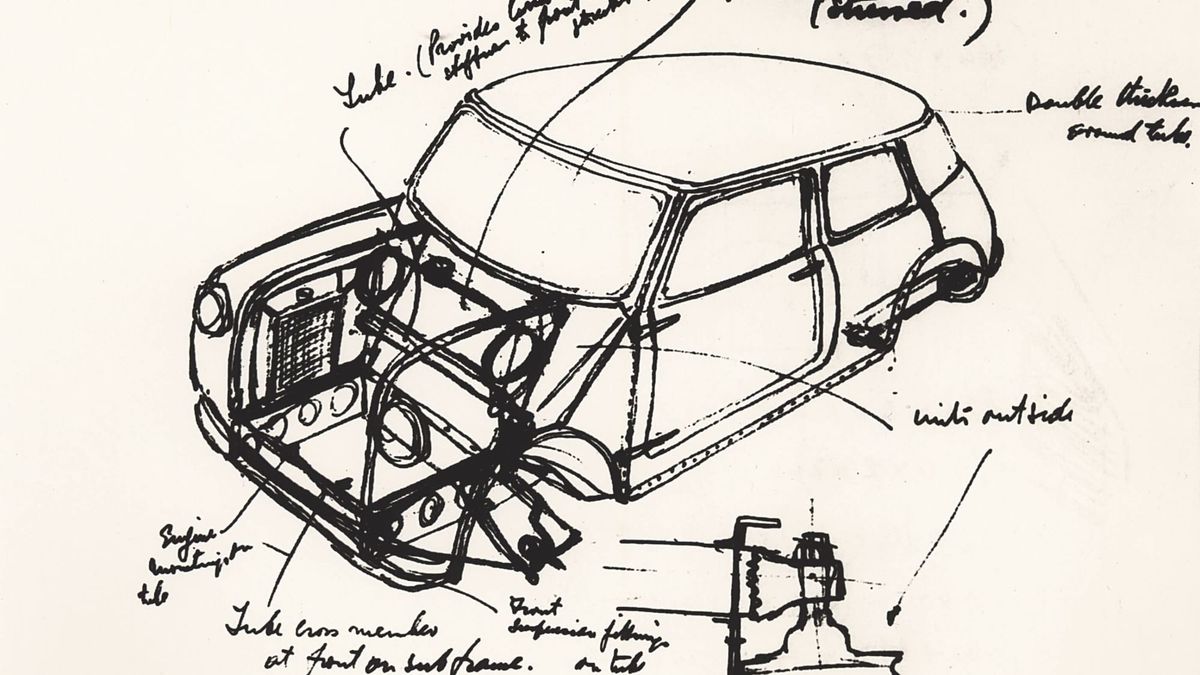
When Ford's engineers bought a Mini in 1959, stripped it to its last bolt, and priced every component, they arrived at an uncomfortable conclusion: BMC was selling the car at a loss. That paradox - a revolutionary machine priced below its own cost to exist - says more about Alec Issigonis and the original Mini's design than any single specification.
Issigonis came to the Mini sideways, through crisis. The Suez Canal nationalisation of 1956 sent British petrol prices surging and car sales collapsing overnight, and BMC chairman Sir Leonard Lord needed a small, fuel-efficient car faster than the industry normally breathed. He turned to Issigonis - already the father of the Morris Minor, the first British car to sell a million units - and handed him constraints so severe they might have broken a lesser engineer: no more than three metres long by 1.2 metres wide, passenger accommodation consuming at least 1.8 metres of that length, and a price point accessible to ordinary working people. Issigonis's genius was treating those constraints not as limits but as a design brief.
The solution he arrived at by late 1957 was a cluster of ideas that had never before appeared together in a production car. The A-Series engine was mounted transversely - sideways across the engine bay - with the gearbox tucked beneath it, sharing the engine's own oil sump. Front-wheel drive completed the package, freeing the entire floor from a propshaft tunnel. Ten-inch wheels, tiny by any standard, pushed to each corner of the body. The result was a car in which eighty percent of its floor area was given over to passengers and luggage. Ferrari's chief designer Aurelio Lampredi tried a pre-production example at the 1959 Italian Grand Prix and returned reportedly declaring: "If it wasn't so ugly, I'd shoot myself" - a line that captures both the car's brilliance and the genuine aesthetic discomfort it provoked in people trained to see beauty in proportion.
The suspension was equally unconventional. Alex Moulton's rubber cone system replaced conventional steel springs, keeping unsprung weight minimal and floor height low while delivering a ride quality that surprised everyone. It also gave the Mini a handling character entirely disproportionate to its engine size - taut, communicative, almost kart-like - which John Cooper recognised immediately. The Cooper and Cooper S variants, arriving from 1961 with 997cc and later 1071cc engines, twin SU carburettors, and front disc brakes, transformed what had been a clever economy car into a genuine motorsport weapon, winning the Monte Carlo Rally three times. Issigonis himself was famously indifferent to performance cars and reportedly irritated by Cooper's modifications - a contradiction that the Mini's story never quite resolves.
The car was not without real flaws. Issigonis had an engineer's disdain for market research and a designer's confidence that occasionally curdled into stubbornness. The gearchange was agricultural, the driving position strangely upright, and the cabin damp in British weather, with door-pocket bins that doubled as puddles. Later iterations - Hydrolastic suspension from 1964, various trim upgrades through the 1970s - addressed some of these while introducing new compromises. The car was famously difficult and expensive to manufacture, requiring specialist roller-welding equipment not used anywhere else in the BMC plant. That Ford could prove it was being sold below cost suggests BMC's management never fully solved the equation Issigonis had set them.
Yet the cultural weight is undeniable. Knighted in 1969, Issigonis watched the car he had designed in two years become the template for virtually every small car produced in the following decades. Transverse engines and front-wheel drive are now so universal that it is easy to forget they were exotic in 1959. The Mini sold over 5.3 million units across four decades before production finally ended in 2000, outlasting the company that built it, the empire that surrounded it, and every rational calculation about its commercial viability. That a car designed under fuel-rationing duress by a Greek-born engineer who disliked market research and hated going fast became the defining object of British motoring culture is, in the end, the most Issigonis-like thing about it.