British Motor Corporation (BMC) and International Licensing
The only way to understand what BMC's licensing strategy actually was - and why it simultaneously looked like foresight and amounted to something closer to managed retreat - is to remember that the company spent most of its life outside the European Economic Community's tariff walls while its most dangerous rivals sat comfortably inside them.
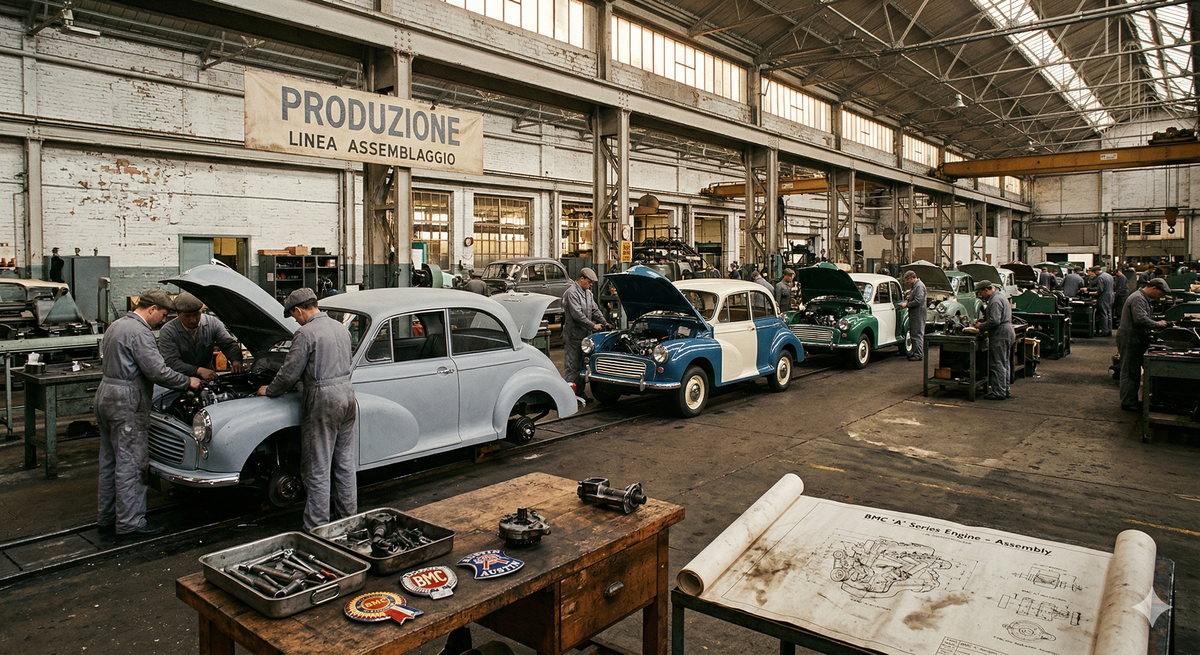
BMC was born in 1952 from the merger of Austin and Morris, two companies that between them had spent the postwar years trying to reconquer export markets that had kept Britain's economy solvent during the war. The logic of internationalisation was therefore baked in from the start, and the tool BMC reached for most readily was the licensing agreement - not because it was the most profitable instrument available, but because import tariffs, foreign exchange restrictions, and nationalist industrial policies in country after country made direct exporting practically impossible. The company's answer was to export the engineering instead.
The breadth of what followed was genuinely remarkable. By the 1960s, BMC had established 21 plants overseas, operating as subsidiaries, joint ventures, or licensed manufacturers across five continents. In Australia, a 1953 facility at the former Victoria Park Racecourse in Sydney began with simple marshalling of fully imported Morris cars and grew into a full-scale manufacturing operation, building engines and bodies entirely from local materials. In Denmark, where postwar trade restrictions made imported cars prohibitively taxed, local assembly preserved market share that would otherwise have vanished. In Spain, the AUTHI factory in Pamplona produced Austin and Mini variants from 1963 to 1975, a venture whose eventual fate - purchased by SEAT and later absorbed into Volkswagen, with the Pamplona plant eventually building the VW Polo - carries its own sardonic footnote about whose industrial project survived.
Italy brought the most culturally resonant chapter. In 1959, BMC struck a licensing deal with Innocenti, the Milan-based manufacturer better known for the Lambretta scooter, to produce the Austin A40 and later the Mini for the Italian market. The Innocenti Mini became a genuine Italian object - refined in trim, slightly softened in interpretation, and genuinely loved in a country that might otherwise have dismissed it as a foreign curiosity. BMC's contract included a clause granting first refusal on any sale of Innocenti, which eventually triggered a full acquisition - after which BMC's management reportedly regarded the scooter side of the business as a distraction, contributing to the Lambretta's eventual demise and the sale of its manufacturing rights to the Indian government. The licensing arrangement had drawn BMC into territory it neither understood nor wanted.
Turkey produced the longest legacy. BMC Turkey, established in 1964 as a joint venture with Turkish partners holding 74 percent of the capital, went on outliving every corporate iteration of its British parent. By 2002, it was exporting commercial vehicles back to Britain - the BMC name returning to British roads decades after it had disappeared from every British-registered organisation that once owned it. That particular irony writes its own conclusion about which half of the partnership proved more durable.
The structural problem with BMC's international licensing approach was that it dispersed engineering value without building lasting commercial advantage. Ford and General Motors, operating German subsidiaries inside the EEC, could sell across Europe without tariff penalties while BMC paid heavily for every car shipped from Longbridge. The licensing deals produced revenue and maintained presence, but they also meant BMC's technology - including the Mini's revolutionary transverse-engine package - was being manufactured and refined by partners who sometimes took the platform further than the originating company. Innocenti's later Bertone-bodied Mini variants, produced after British Leyland had taken over and begun dismantling the Italian relationship, were regarded by many Italian buyers as superior objects to anything emerging from Cowley.
The honest verdict is that BMC's international licensing programme was an intelligent solution to structural disadvantages that BMC's own management never fully resolved at home. It kept the brand present across markets that a purely export-led strategy could not have reached, and it planted seeds - in Turkey, in Australia, in Spain - that outlasted the corporation itself. But licensing technology to partners is not the same as building a global company, and BMC never quite made that transition. The deals were reactive, shaped by tariffs and politics rather than strategic vision, and the legacy they produced was more accidental than designed - which, in retrospect, feels entirely in keeping with how BMC managed most things.