Bugatti Veyron Grand Sport 'Soleil de Nuit': One of One'
The Bugatti Veyron Grand Sport 'Soleil de Nuit' is a one-off masterpiece: polished aluminium meets midnight blue on the world's fastest open roadster.
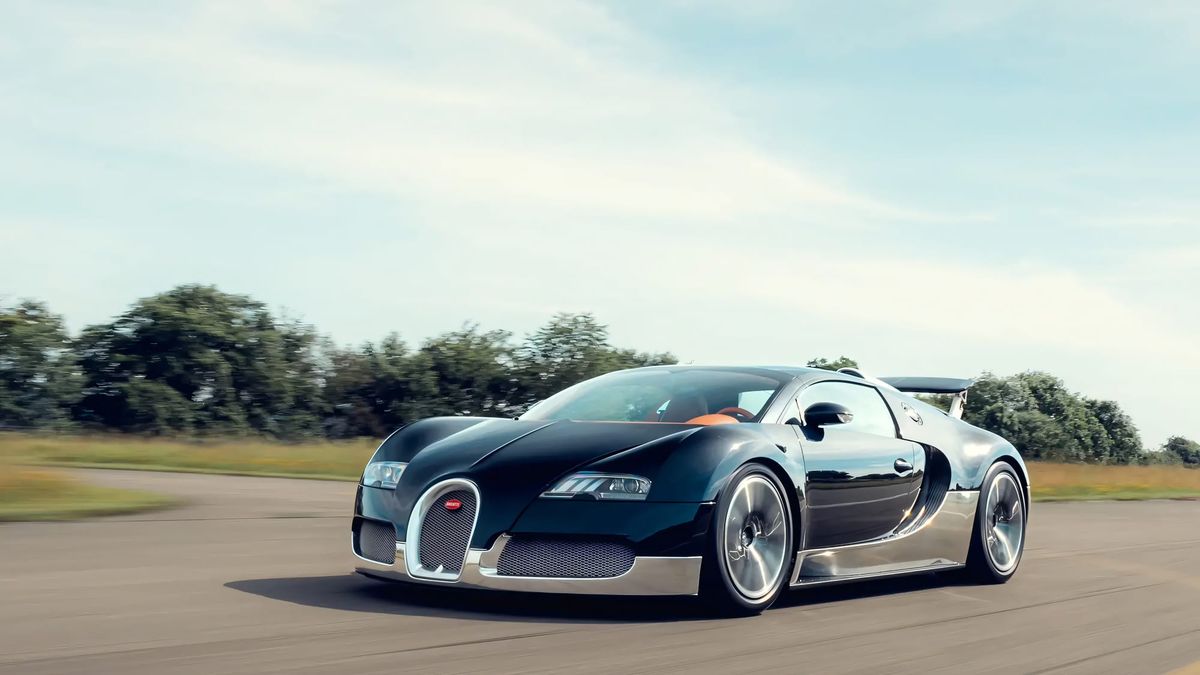
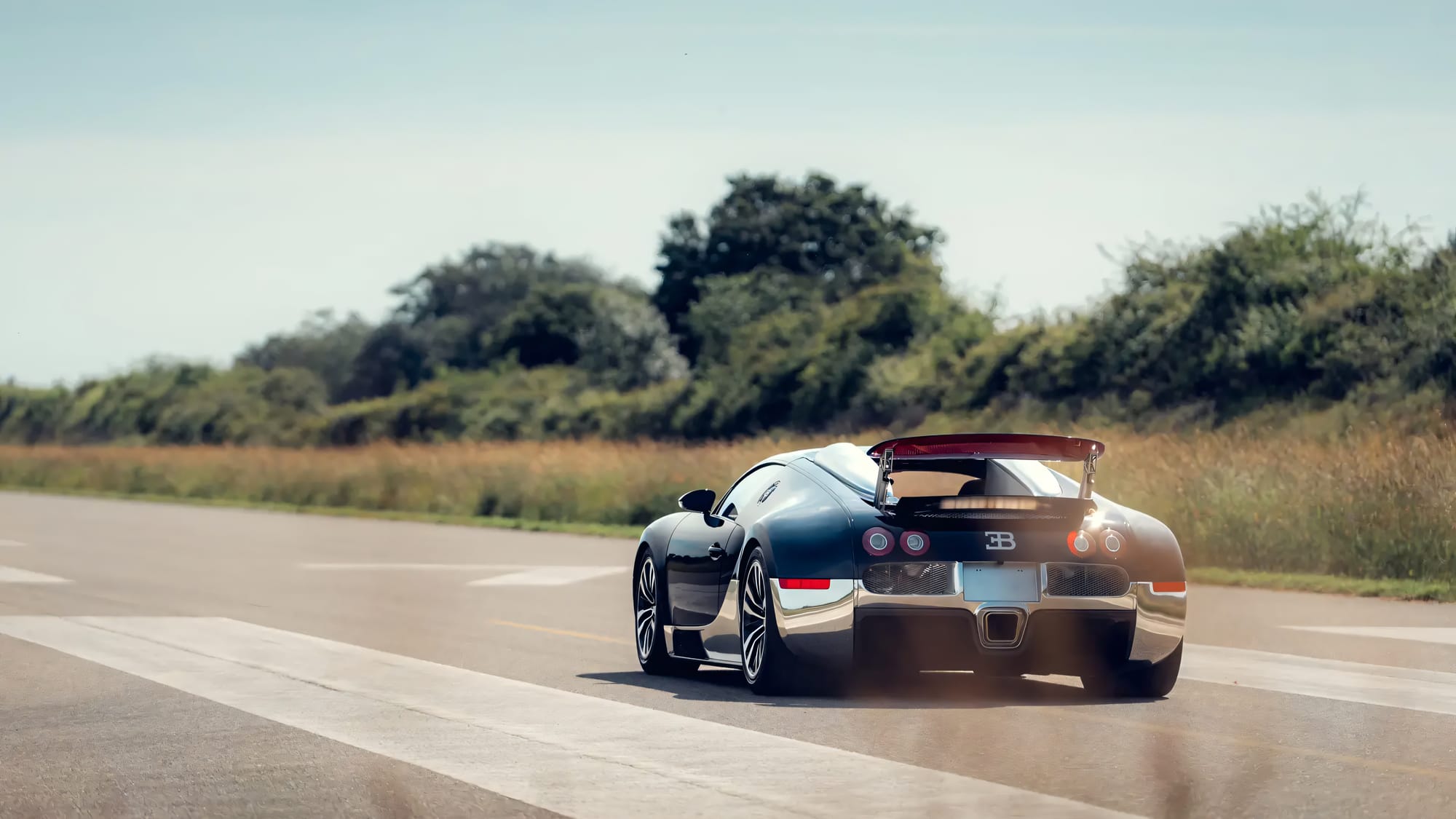
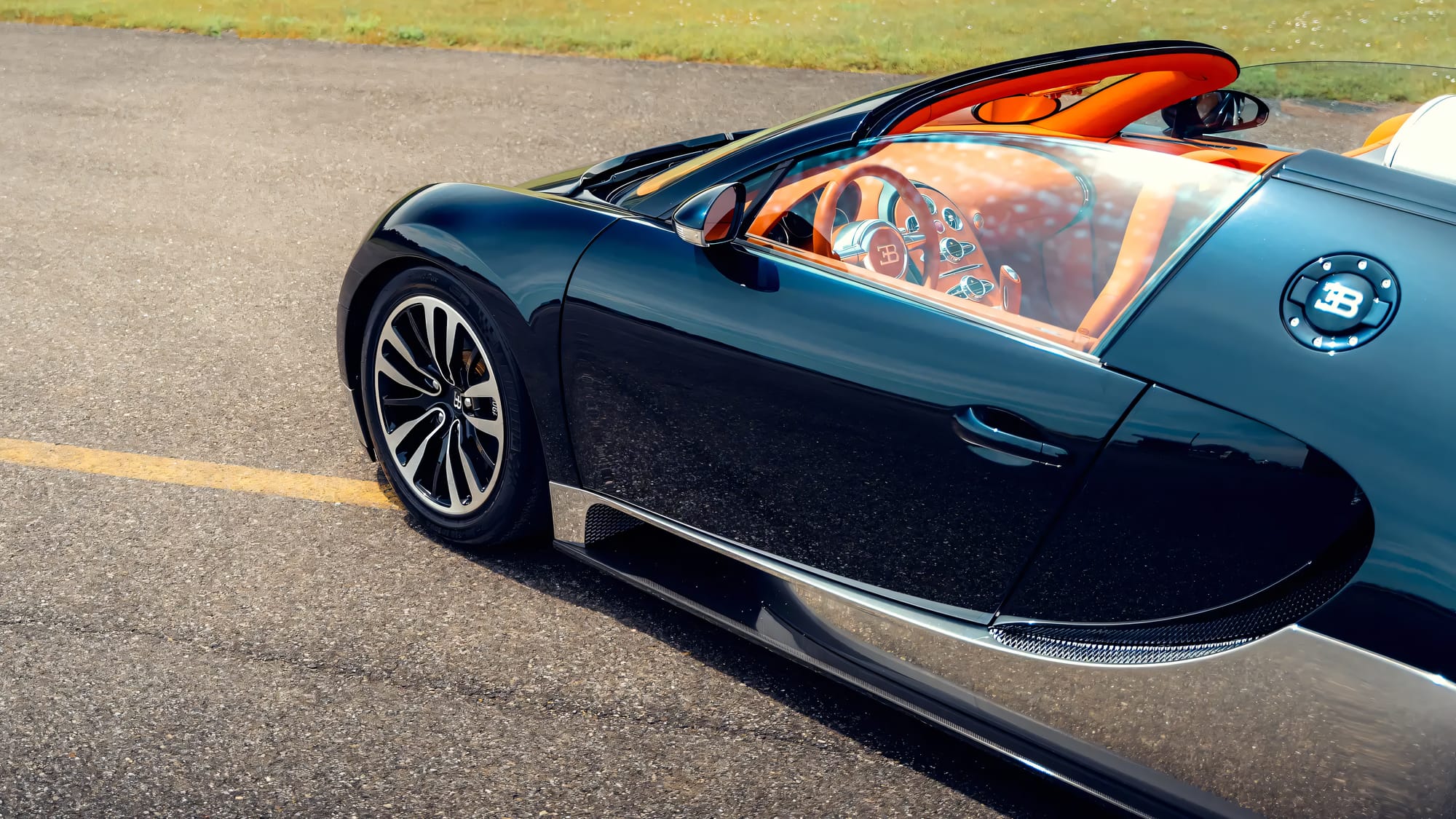
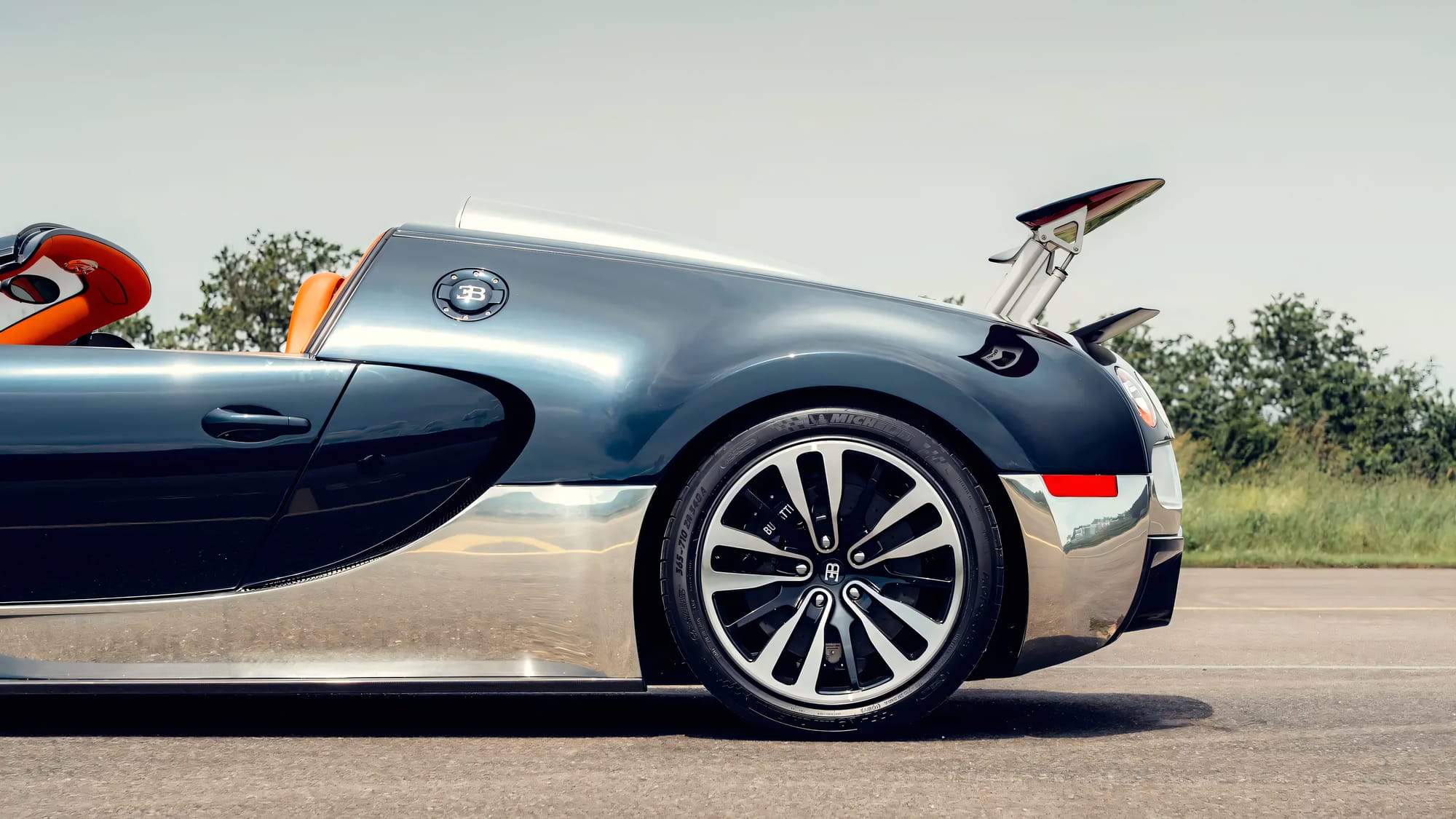
Soleil de Nuit - Sun of Night. The name is a deliberate contradiction, the kind of poetic paradox that only a French atelier could commission with a straight face and actually make work. Stand beside this particular Grand Sport and the logic becomes unexpectedly clear: the lower bodywork catches daylight in polished aluminium, throwing it back like a mirror held flat to the sky, while the upper surfaces dissolve into Black Blue Metallic - that saturated darkness that exists somewhere between midnight and the deep ocean. The underside of the rear wing is Italian Red, hidden from view unless you know to crouch and look. It is a car that reveals itself in stages, each angle offering something new, much like the desert sky it was conceived to honour. Bugatti built exactly one of these.
To understand why this particular car exists at all, you need to trace the Veyron's origins back to a man with an obsession rooted not in road-car bragging rights, but in the specific, wind-blasted drama of Le Mans. Ferdinand Piëch - grandson of Ferdinand Porsche and the man who would eventually chair Volkswagen Group - was Porsche's motorsport director when the 917 recorded 362 km/h along the Mulsanne Straight in period. That figure lodged in him. When a specially prepared Peugeot P88 prototype later attacked the same straight and clocked 407 km/h, Piëch had a concrete target: build a road car that eclipses it. Not faster than other road cars, specifically - faster than a Le Mans prototype. The ambition was almost deranged in its scale, and it took Volkswagen Group's vast engineering resources, a decade of development, and a reported loss of roughly €5 million on every car sold to actually deliver it. The production Veyron 16.4, revealed in 2005, hit 408.47 km/h at the Ehra-Lessien test track. Mission accomplished. Piëch got his number.
The engineering required to reach that figure is still staggering to consider even now, over two decades on. The W16 engine - essentially two narrow-angle V8s sharing a common crankshaft - displaces 7,993cc and breathes through four turbochargers arranged in pairs, with an intercooler dedicated to each pair. In standard Veyron specification it produces 1,001 PS and 1,250 Nm of torque, figures that in 2005 existed in a category entirely their own. The transmission is a seven-speed dual-clutch DSG unit, and the four-wheel-drive system was developed specifically to cope with the torque loads involved. At full chat the engine consumes air at a rate that required Bugatti to engineer two separate air intakes - the familiar NACA ducts along the flanks - because a single opening of adequate size would have structurally compromised the bodywork. The car burns through a full tank of fuel in approximately twelve minutes at top speed. Bugatti fitted a specific key - the speed key - that must be inserted into a separate slot to disable the aerodynamic limiters and allow the car to reach its maximum velocity. Without it, the Veyron is electronically capped at 375 km/h. Even that feels faintly absurd as a consolation prize.
When Bugatti introduced the Grand Sport at Pebble Beach in August 2008, the challenge was adapting this engineering monument for open-air motoring without turning it into either a structural disaster or an aerodynamic compromise. The solution was a removable polycarbonate roof panel that slots into place above the occupants, along with a fabric soft-top for emergency use if weather turns. The polycarbonate piece is transparent - more canopy than roof - and gives the interior a hothouse quality in direct sunlight that not everyone loves. The fabric hood, meanwhile, is strictly a get-home measure rather than a genuine convertible roof; it limits speed to 130 km/h when deployed. Bugatti acknowledged these constraints honestly rather than pretending they didn't exist, which is to the company's credit. The result was still classified as the world's fastest open roadster at its launch, with the same quoted 407 km/h maximum as the coupé when the polycarbonate panel is in place - though achieving that figure requires the dedicated speed key, a suitably long straight, and a considerable measure of personal composure.
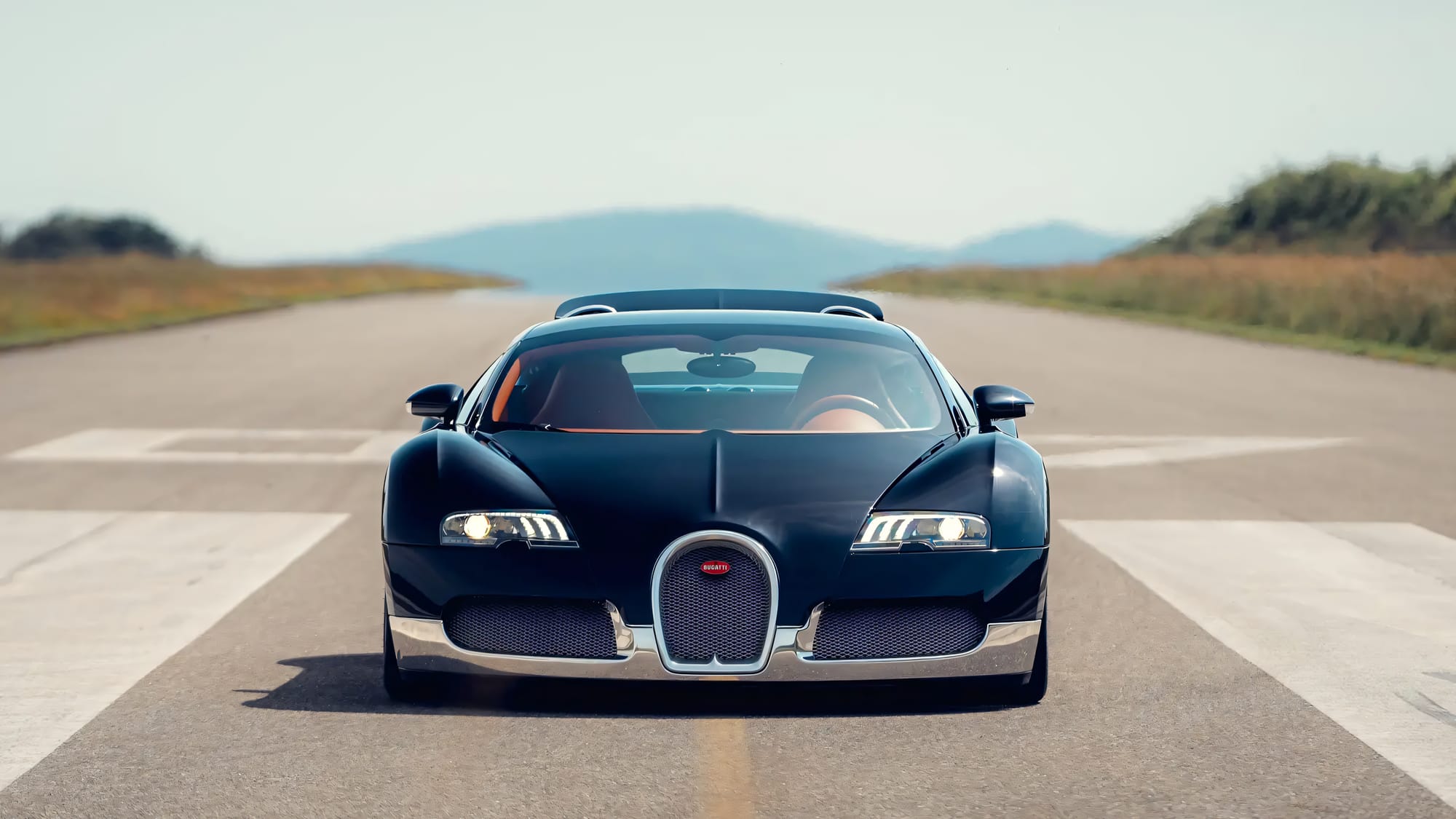
The 'Soleil de Nuit' emerged from this context as a commission for the Middle Eastern market, where the Grand Sport had found an enthusiastic audience. Presented at the Dubai International Motor Show in November 2009, it was the only one of its kind, built to a specification that is at once restrained and theatrical depending on which surface catches the light. The polished aluminium lower body is not paint - it is the material itself, left exposed and finished to a mirror sheen, a treatment that requires extraordinary preparation of the underlying aluminium panels and creates a maintenance commitment that most coachbuilders would politely decline. Above the beltline, the Black Blue Metallic is deep and absorbing. The contrast between the two finishes shouldn't work and somehow does entirely. The wheels are the diamond-cut items worn by the 'Sang Noir' limited series - twelve cars inspired by the Type 57S Atlantic - with their distinctive machined faces lending an almost Art Deco jewellery quality to the flanks. The Italian Red wing underside is the kind of detail you include not because anyone will routinely see it, but because it tells you something about how Bugatti approached the commission: completely, including the parts that face downward.
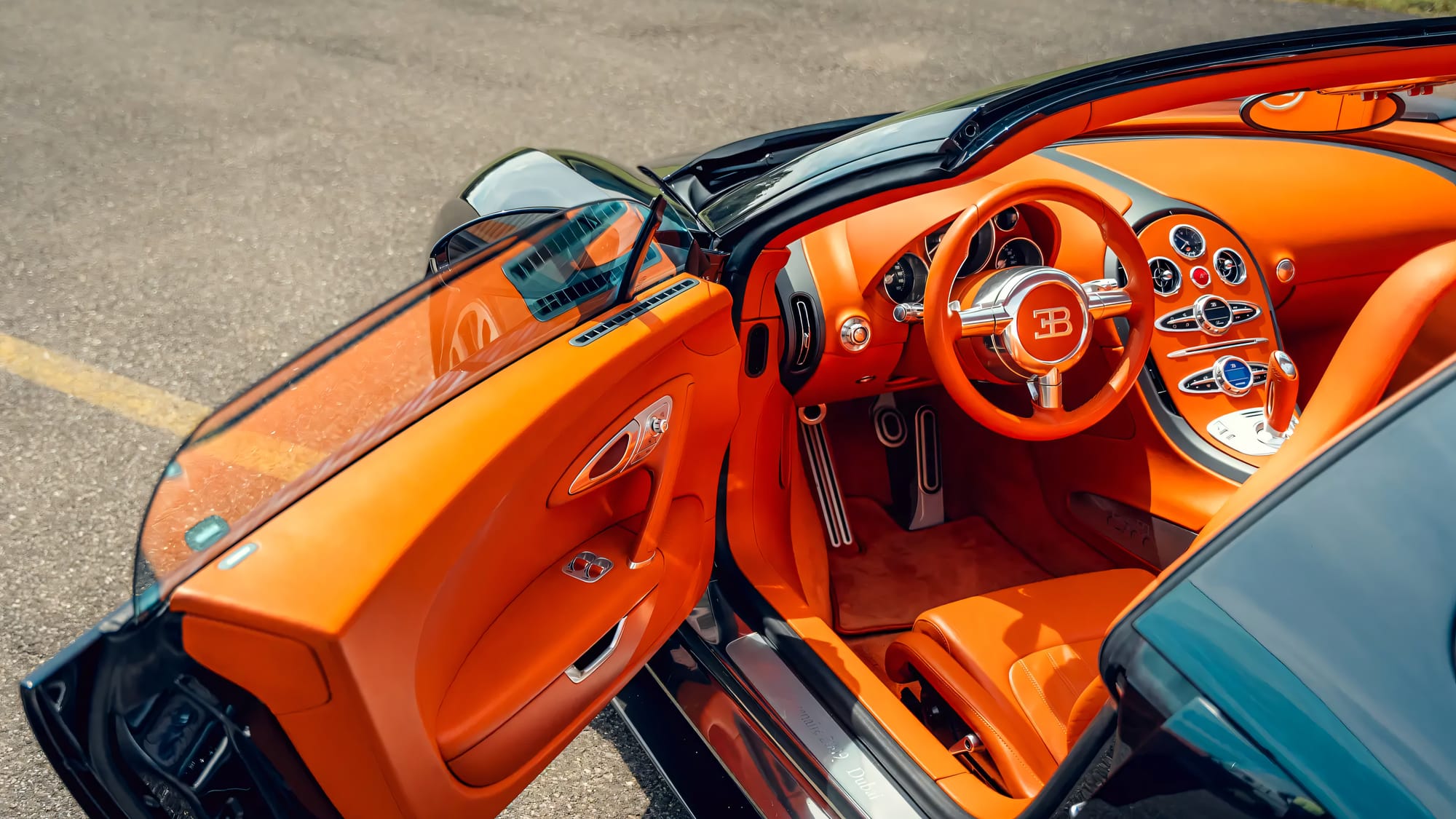
Inside, Burnt Orange leather covers every surface that would accept it, and the effect in sunlight against the exterior's dark tones is genuinely arresting - a warmth that reads as deliberately solar, a chromatic argument in favour of the car's name. The 'Soleil de Nuit' logotype appears stitched into the headrests and rendered on plaques at the door sills and centre console. It is the kind of interior that polarises: some find the single-colour saturation of a bespoke Veyron cabin overwhelmingly rich; others find it exactly right for a car in which restraint was never the primary brief.
On the road, the Grand Sport demonstrates the particular genius and the particular frustration of the Veyron simultaneously. At urban speeds it is surprisingly tractable, the DSG transmission managing the engine's mass of torque with genuine civility, the ride quality - while firm - never punishing. The steering is accurate if somewhat insulated, delivering position and load but filtering out texture, which feels like a deliberate trade-off for a car operating at the speeds involved. As velocities rise the Veyron transforms: the body lowers on its hydraulic suspension, the rear wing extends and tilts, the ride firms further, and the car acquires a sense of planted, absolute purposefulness that nothing else in the road-car world quite replicates. The W16's power delivery is not the explosive, peaky surge of a highly strung naturally aspirated engine; it is continuous, inexorable, and slightly unnerving in the way that truly large forces are always slightly unnerving. The sound, through the open Grand Sport body, is a layered conversation between turbo rush, exhaust note, and mechanical voice that enthusiasts find endlessly interesting and that casual passengers occasionally find overwhelming.
The compromises are real and worth naming. The Veyron is large and heavy - the Grand Sport weighs approximately 1,990 kg - and while the structure is extraordinarily stiff for a convertible of its complexity, it is not the kind of car that invites you to explore a mountain road. It rewards straight-line velocity and high-speed grand touring; it does not reward being hustled. The braking system - carbon ceramic discs with a retractable air brake that rises from the rear deck under heavy deceleration - is genuinely exceptional, one of the engineering highlights of the whole package. But the car's girth and mass mean that in any environment where changing direction matters, a well-sorted sports car costing a fraction of the Veyron's price will feel more alive. Bugatti never claimed otherwise. This is a car built to a specific brief, and that brief was always about absolute capability rather than driver engagement in the traditional sense.
There is also the matter of what it costs to maintain. The Veyron's service requirements are extensive, involving a dedicated Bugatti-approved workshop and parts and labour costs that make conventional servicing bills look trivially small. The tyres are bespoke Michelin items designed specifically for this application; replacement involves removing the wheels from the car and shipping them to a facility equipped to handle the procedure. None of this is unknown to buyers, but it bears acknowledgement: the Veyron is a car that requires commitment well beyond its purchase price.
What the 'Soleil de Nuit' represents within this context is something genuinely rare even within a rare model range. Bugatti produced 150 Grand Sport examples across the standard production run, a figure that already places it in rarefied company, and within those numbers the bespoke commissions - cars built to individual specifications for individual markets - are a distinct subset. A one-off Grand Sport wearing a unique exterior treatment, interior specification, and dedicated badging occupies a position that is genuinely singular. It was conceived for a specific cultural context, delivered to one of the most prominent families in its target region, and carries a visual identity that no other car shares. The Dubai Motor Show unveiling gave it a public debut appropriate to its ambitions: a market that understood implicitly what Bugatti was communicating with polished aluminium and midnight blue.
The Veyron's broader legacy has only become clearer with distance. When it appeared in 2005, some critics questioned whether the world needed a car of such extreme specification, and whether the engineering resources required to build it represented a rational allocation of effort. Those arguments were never really the point. The Veyron demonstrated, definitively, what was possible when an automotive group committed its full engineering capability to a single goal without commercial compromise. It reset expectations across the hypercar sector, encouraging Koenigsegg, Hennessey, and SSC to pursue records that would not have seemed viable without Bugatti's precedent. It also demonstrated that a hypercar could be genuinely usable - not just as a straight-line machine but as a car capable of covering distance, in reasonable comfort, at extraordinary speed. The Chiron that followed built on this template rather than replacing it, which is perhaps the clearest evidence of how well the original concept was conceived.
The 'Soleil de Nuit' was received with the kind of attention that a one-off Veyron commission naturally generates - admired in Dubai, discussed in the specialist press, and subsequently absorbed into private ownership with the discretion typical of its buyer profile. It is not a car that sought widespread public approval, and it did not need to. It was built for a specific audience, in a specific specification, to mark a specific moment in Bugatti's centenary year. That it now exists as a document of that moment - of a company at the peak of its original Veyron programme, producing bespoke commissions for buyers who understood exactly what they were asking for - gives it a historical dimension that purely statistical rarity cannot fully capture.
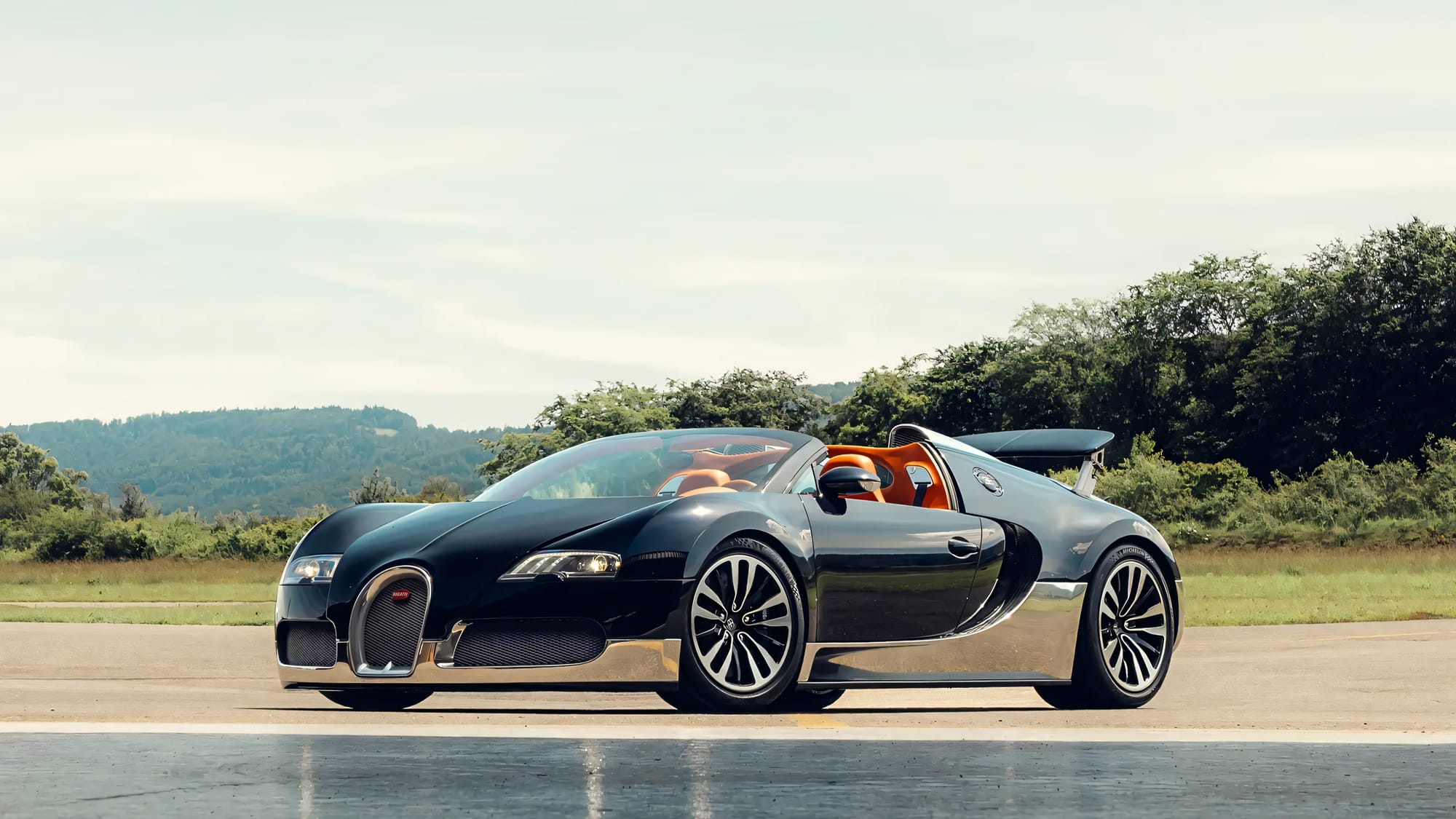
The name still makes its own quiet argument. Soleil de Nuit. A sun that shines in darkness, polished aluminium catching whatever light is available and giving it back doubled. It was a strange brief for a car, and Bugatti fulfilled it completely.