William Lyons and Jaguar's Postwar Identity
The name change happened quietly, without ceremony, in 1945 - a single resolution removing "SS Cars Limited" from the company register and replacing it with "Jaguar Cars Limited." William Lyons understood, with the instinctive acuity that characterised everything he did, that the letters SS had acquired a meaning during the preceding six years that no amount of engineering brilliance or design elegance could survive. In that act of renaming - pragmatic, swift, uncommented upon - lay the essence of how Lyons operated: he made decisions that were simultaneously about the immediate commercial reality and about something much longer and more abstract, which was the idea of what Jaguar should be.
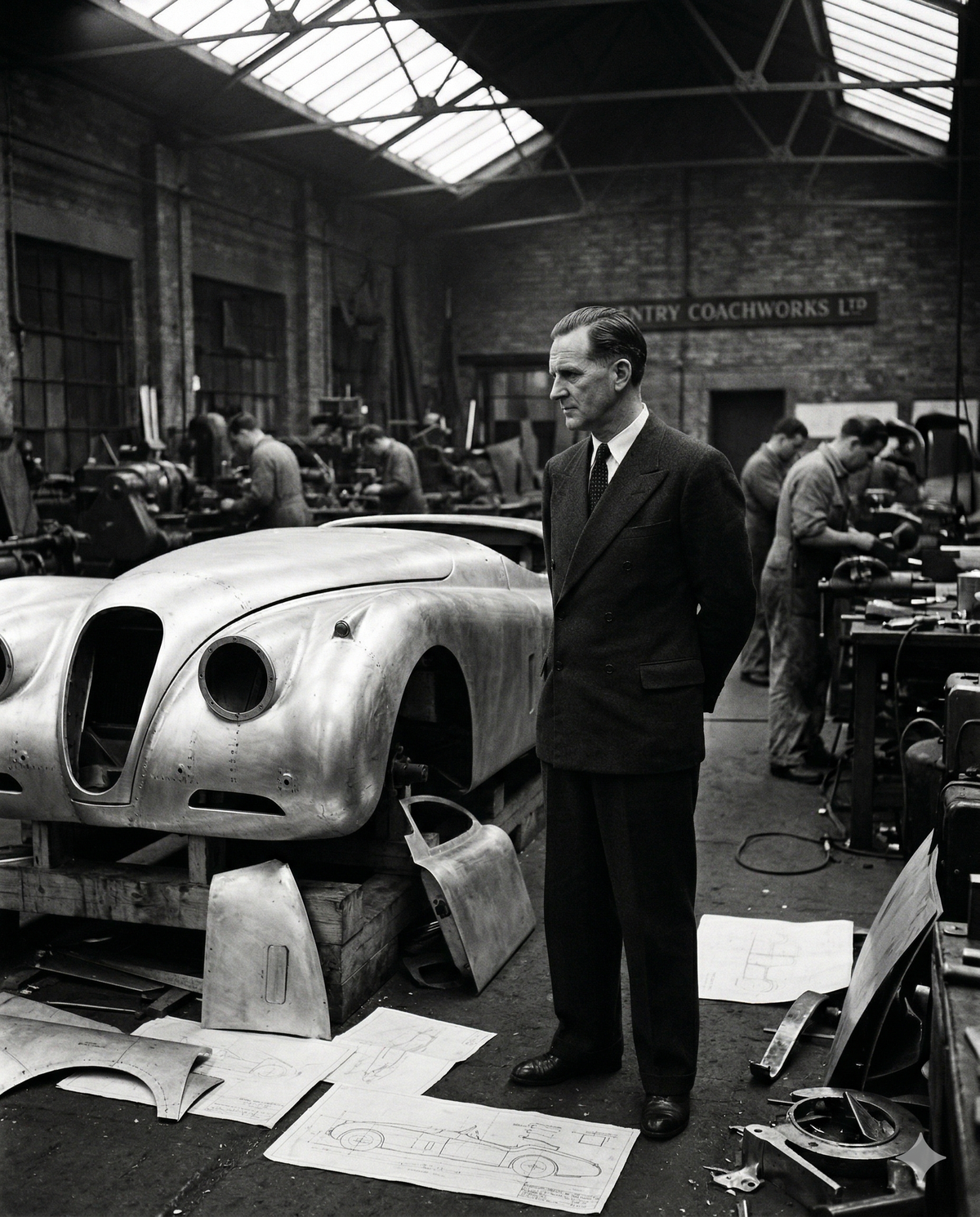
Lyons was not, in any conventional sense, an engineer. Born in Blackpool in 1901, he had come to the car business through sidecars, then through coachbuilding - fitting handsome bodies to other manufacturers' chassis at prices that alarmed competitors who couldn't understand how he turned a profit. The answer was partly his relentless personal involvement in production efficiencies, but more fundamentally it was his eye. Lyons designed by instinct and iteration, walking around prototypes, ordering body panels reshaped by fractions of an inch, tilting a roofline, lowering a bonnet - operating without formal training in the way a gifted tailor operates, by proportion and feel rather than formula. The results were cars that looked as though they should cost far more than they did, which was precisely the point.
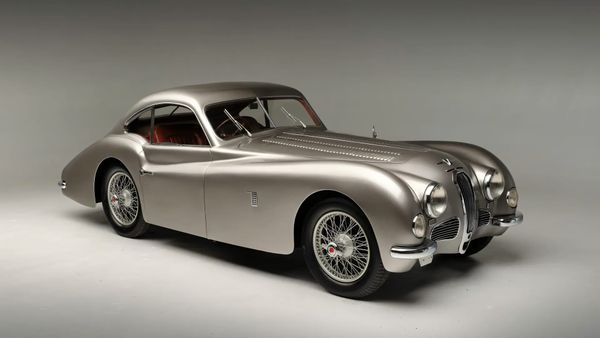
The postwar Jaguar identity crystallised around a single, daring product decision: the XK120, unveiled at the 1948 London Motor Show with a twin-cam engine developed largely in secret during the war years and a body of such refined proportion that the motoring press struggled to find adequate vocabulary. Lyons had intended the engine as a saloon unit; the sports car body was almost an afterthought, a showcase for the engine - then public response forced him to put it into production immediately. That episode captures the accidental-deliberate quality of Lyons's genius: preparation meeting opportunity and emerging as something that looked entirely planned.
The phrase he formulated - "a Jaguar should be a copy of nothing" - was not marketing language but operational doctrine. It explains the in-house engine development when buying units from Standard Motors would have been easier and cheaper. It explains the Le Mans programme, which Lyons supported not from racing mania but because it generated the kind of credibility that advertising could not purchase. It explains his resistance, often frustrating to engineers, to technical complexity for its own sake - the XK engine's architecture was elegant precisely because Lyons kept pushing back against over-engineering, insisting that beauty and function should arrive at the same point.
The limitation embedded in this philosophy was real. Lyons's dominance meant that Jaguar's development pace was constrained by one man's attention and appetite for risk. The merger with BMC in 1966, and the subsequent absorption into British Leyland, represented the exhaustion of a model where a single personality had sustained a company's identity almost entirely by force of character. Lyons remained as chairman nominally until 1972, but the Jaguar he had built - economically fragile, structurally under-resourced, but extraordinarily coherent in its values - was already becoming something else.
What he left behind was not a product range but a sensibility: the proposition that a car could be beautiful, fast, and within reach of a professional salary, that these three things were not in tension but were in fact the same ambition expressed three ways. Every subsequent Jaguar that has succeeded has succeeded on those terms. The ones that have failed - and there have been many - have failed by abandoning one of the three legs of that particular stool. The 2024 rebrand that reached back to his "copy nothing" phrase, seventy years after he coined it, was Jaguar acknowledging that no one since has improved on the brief. That is either a tribute to his foresight or an indictment of what followed. Possibly both.