Turin Motor Show - History and Italian Debuts
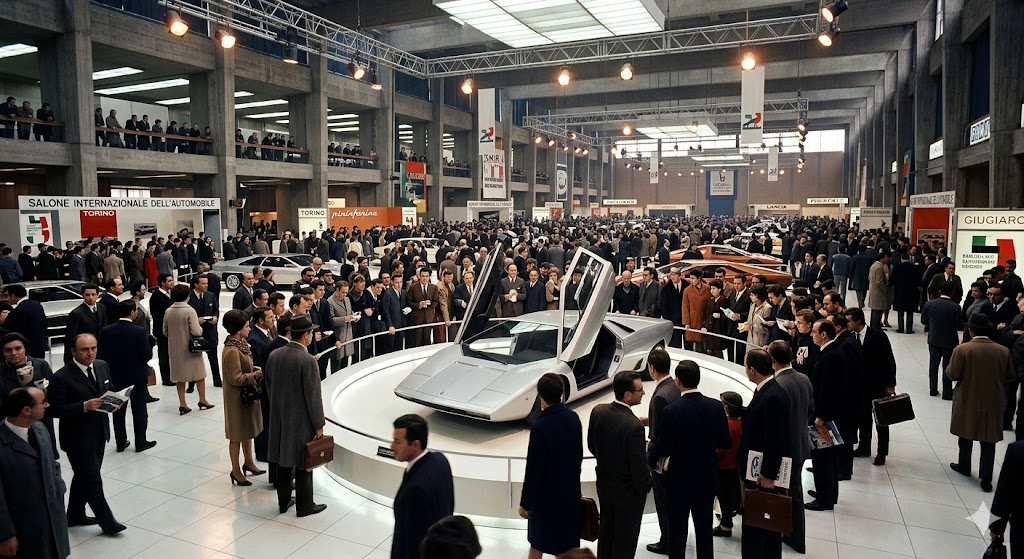
In November 1965, Lamborghini brought a bare chassis to Turin and called it a motor show exhibit. No bodywork. No interior. No doors. Just 120 kilograms of folded and drilled steel sheet, a transverse V12 sitting behind where the driver would eventually be, and twelve Weber carburetor trumpets pointing straight up like an act of deliberate provocation. The crowd didn't know what to do with it - and that precise confusion, that moment of the audience trying to calibrate what it was looking at, is the sensation that defined the Salone dell'Automobile di Torino at its finest.
The show's first official edition dated to April 1900, held at the Castle of Valentino by a city that already understood what the automobile represented to Piedmont's industrial future. Turin was not simply a convenient host venue - it was the place where Fiat had been founded the previous year, where the supply chains, the engineering culture, and the commercial ambition to build motorcars were already concentrated. The Salone was from its beginning less a trade fair than a homecoming, an annual moment when the industry came back to the city that had arguably invented it in its Italian form.
What made Turin different from Paris, Geneva, or Frankfurt in the postwar decades was the density of coachbuilding talent that surrounded it. Bertone, Pininfarina, Ghia, Vignale, Zagato, and Italdesign all had studios within reach of the exhibition halls, which meant that the Salone routinely received concept cars that had been designed, built, and delivered within months of the event rather than years. This geographic compression produced a creative intensity that no other motor show could quite replicate. The 1950 show gave the world the Lancia Aurelia, displayed on a revolving flowerbed alongside a naked chassis - the same pedagogical instinct that Lamborghini would employ to spectacular effect fifteen years later. The 1953 show introduced both the Lancia Appia and the Alfa Romeo 1900 Super Sprint. The 1957 show brought the Giulietta Sprint Speciale from Bertone and the Lancia Florida II from Pininfarina in the same season.
The sequence of debuts through the late 1960s and early 1970s represents a sustained period of creative exhibition that no motor show in history has surpassed for density of genuine significance. The 1969 Turin show brought the Lancia Stratos Zero - Gandini's most extreme concept, its windscreen and side glass forming a single unbroken ellipse, entry via a hinged nose panel. The Iso Rivolta Lele debuted in the same year at the same show, a reminder that Turin was not only about spectacle but about serious production intentions dressed in Italian coachwork. The 1971 show introduced the Countach LP500 prototype, and the automotive press reached for language it didn't quite have.
The Salone's authority rested partly on timing and partly on honesty. Turin happened in late autumn, after Geneva in the spring, and the Italian manufacturers used it as their domestic platform - a place to announce what they were actually building, not only what they were capable of imagining. This gave the show a particular weight: a debut in Turin carried the implication of production intent in a way that concept showings elsewhere sometimes didn't. The Miura chassis of 1965 was the most productive example of this - a bare mechanical statement that compelled the coachbuilders present to bring their proposals directly, and which resolved into the Geneva production reveal four months later.
The show's trajectory through the 1980s and 1990s was less distinguished. European motor show calendars became crowded, manufacturer budgets were rationalised, and the coachbuilding studios whose work had given Turin its particular character were shrinking or consolidating. The Salone moved venues, struggled with attendance, was cancelled and revived. The 2025 edition, revived as a reimagined public festival, saw Chinese brands dominate the stands - a development that would have been incomprehensible to the Bertone and Pininfarina designers who had made the show's reputation, but which reflected with uncomfortable clarity where the next chapter of automotive ambition had located itself.
What the Turin Motor Show represented at its best was the productive collision between a manufacturing city, a cluster of design studios that couldn't have existed anywhere else, and a calendar slot that forced the industry to arrive with something real. The bare Lamborghini chassis of 1965, the Stratos Zero of 1969, the Countach of 1971 - these were not accidental. They were produced by people who understood that in Turin, in November, in front of an audience that included every coachbuilder in Piedmont, there was simply no point arriving with anything less than a declaration.