The ZF Power Steering System in Postwar Grand Tourers
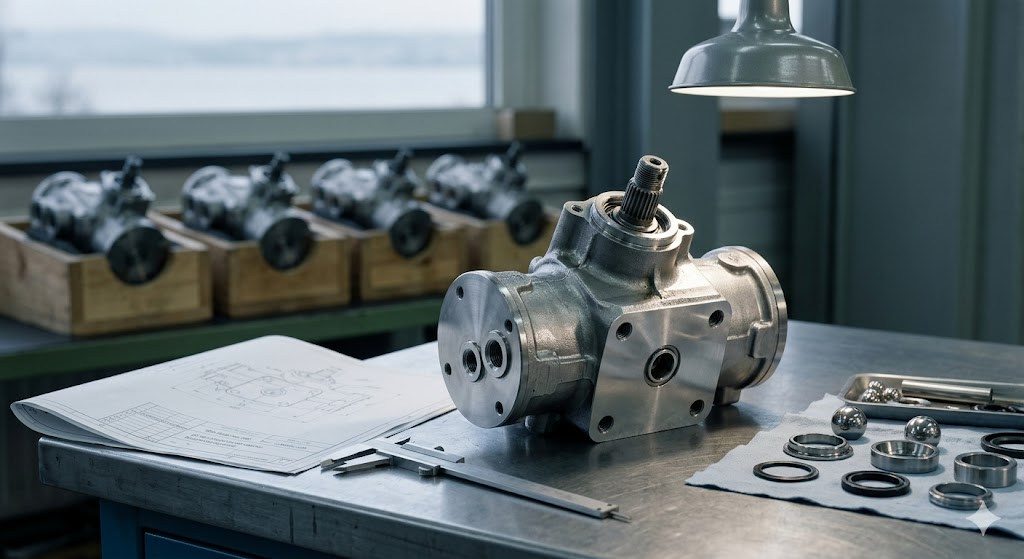
The engineers at Friedrichshafen had spent the first half of the twentieth century making gears for Zeppelin airships, then transmissions for automobiles, then weapons components for a government they had no particular enthusiasm for, and then transmissions for automobiles again. By the time the postwar grand-touring market began demanding that its cars be both genuinely fast and genuinely effortless to pilot, ZF was already positioned - through circumstance as much as strategy - as the only European supplier with both the precision manufacturing culture and the product breadth to answer. The power steering systems they began supplying to the luxury car trade in the late 1950s were, in a quiet and largely unheralded way, the component that made the modern grand tourer possible.
The fundamental problem that ZF's hydraulic steering boxes solved was not weakness. The drivers buying Bristol 409s, Alvis TE 21s, and Rolls-Royce Silver Shadows in the early 1960s were not, as a category, unable to turn a steering wheel. The problem was character. A 1,600-kilogram saloon running large-section crossply tyres and a long-wheelbase chassis for high-speed stability required steering geometry that produced enormous self-centring forces - which meant the unassisted wheel fought back at low speeds, in car parks, on wet cobbles, in the precisely the places where composed effortlessness was most expected. ZF's recirculating-ball hydraulic power steering gear, offered initially as a factory option and then progressively standardised, added just enough assistance to remove the physical argument without severing the communication. That balance was the engineering achievement.
The company had entered steering production in 1932 under licence from the American Ross Steering concern, manufacturing worm-and-roller units that were adequate but unremarkable. The move to hydraulic power assistance in the late 1950s was both a technical step and a market positioning decision: ZF understood that Mercedes-Benz, Rolls-Royce, and the smaller specialist manufacturers were all simultaneously arriving at the same requirement, and that the supplier who could deliver a system refined enough for a Silver Shadow would earn a roster of clients that amounted to the entire European quality car trade. They were correct. By the mid-1960s, the ZF power steering box appeared in cars as varied as the Bristol 409, the Alvis TE 21 - where it was added to the options list for the 1965 model year - and Rolls-Royce applications, the last of these building on ZF's transmission relationship that stretched back through the three-speed automatic units supplied to Crewe.
What distinguished the ZF unit from American equivalents was its weighting. Detroit's power steering systems of the same era were almost universally criticised for their complete isolation of the driver from road surface - an approach that suited the American domestic market's preference for effort-free motoring but was considered crude by European standards. ZF tuned their assistance levels to preserve a residual self-centring feel and sufficient road reaction at speed, so the driver always knew where the front wheels were pointing and what the surface beneath them was doing. It was, in the vocabulary of the time, steering that helped without interfering - a distinction that sounds minor but which determined whether a grand tourer felt like a precision instrument or a piece of furniture.
The criticisms of the early ZF power steering installations were honest ones. The hydraulic pump drew power from the engine at all times - a constant parasitic loss irrespective of whether assistance was actually needed - and the early units required periodic attention to maintain their weighting consistency, the feel degrading gradually as seals wore. Bristol 409 owners who neglected their ZF boxes found themselves with assistance that had become either vague or jerky, neither of which was acceptable in a car of that pretension. The fix was a rebuild at a specialist, an expense that was manageable but added a maintenance variable that the pre-power-steering cars with their simpler recirculating-ball boxes had never imposed.
ZF's longer contribution to this segment extended well beyond the steering box. Their five-speed manual transmissions went into the Aston Martin DB6 and the early 911 Porsche; their automatic units were adopted by BMW, Peugeot, and Alfa Romeo through the 1960s; Colin Chapman sourced a modified ZF four-speed for his Lotus Formula One programme after spotting a prototype unit in the Friedrichshafen test department and recognising it for what it was. The steering systems were one line of a much broader intervention in what European performance cars of the era could actually do.
The arc of ZF's power steering development culminated, eventually, in the Servotronic speed-sensitive system of the 1980s - which varied assistance levels according to road speed, providing genuine lightness at parking velocities and progressive weight at motorway pace - and then in the fully electric Servolectric that replaced hydraulics altogether. The grand-tourer owners of 1966 would have considered both developments miraculous. What they had, in their ZF-equipped Bristol 409s and Alvis coupes, was the first generation of a technology that had correctly identified the problem and produced a solution good enough to last a decade before anyone improved on it substantially. In the grand-touring world, where everything was about the quality of the experience rather than the novelty of the technology, that was more than enough.