The Solex Carburettor in Postwar European Engines
Nobody designing a fuel system in postwar Europe wanted complexity. They wanted something that worked in the cold, didn't flood on mountain passes, didn't need a trained technician to rebuild on a Tuesday afternoon, and cost next to nothing to manufacture at scale. The Solex carburettor answered all of those demands simultaneously, which is why by the mid-1950s it was under the bonnets of cars as philosophically opposed as the Volkswagen Beetle, the Citroën 2CV, the Porsche 356, and the Rolls-Royce Silver Cloud. That breadth is not an accident - it is the whole story.
Solex itself was a French operation, founded in 1905 and producing carburettors from the start. Its defining technical insight was the inversed starting device - a separate starting circuit, essentially a primer tube that bypassed the main venturi to deliver an enriched mixture on cold starts without a conventional choke plate. For mass-market cars in a continent still rebuilding its infrastructure, this was not a minor refinement. It meant reliable cold starts for drivers who had no mechanical knowledge, no garage, and sometimes no patience. The Beetle's long run with Solex units - the 28 PCI in the early cars evolving through the PICT series into the 34 PICT-3 of the early 1970s - owed everything to this simplicity. Volkswagen had licensed the design through the German manufacturer Pierburg, which became the dominant supplier in the German market, fitting units to Mercedes-Benz, BMW, Ford, Borgward, and Goliath as well as VW.
The variants proliferated sensibly rather than chaotically. At the small end, the Solex 26 BCI served Citroën's 2CV with its tiny flat-twin, eventually developing into the twin-barrel 26/35 CSIC as the engine grew. At the sporting end, the Solex 40 PII-4 appeared on the Porsche 356, its larger venturi calibrated for an engine that needed throttle response rather than just economy. The Solex 32 PBIC sat on the Citroën Traction Avant's 11CV, while the BMW 501's lightweight V8 used a twin-barrel Solex to produce 95 to 100 horsepower at 4,800 rpm. Each unit was a variation on the same core architecture - downdraught or horizontal orientation, single or twin choke, venturi sized to the application - which made the underlying logic consistent even when the part numbers ran into the thousands.
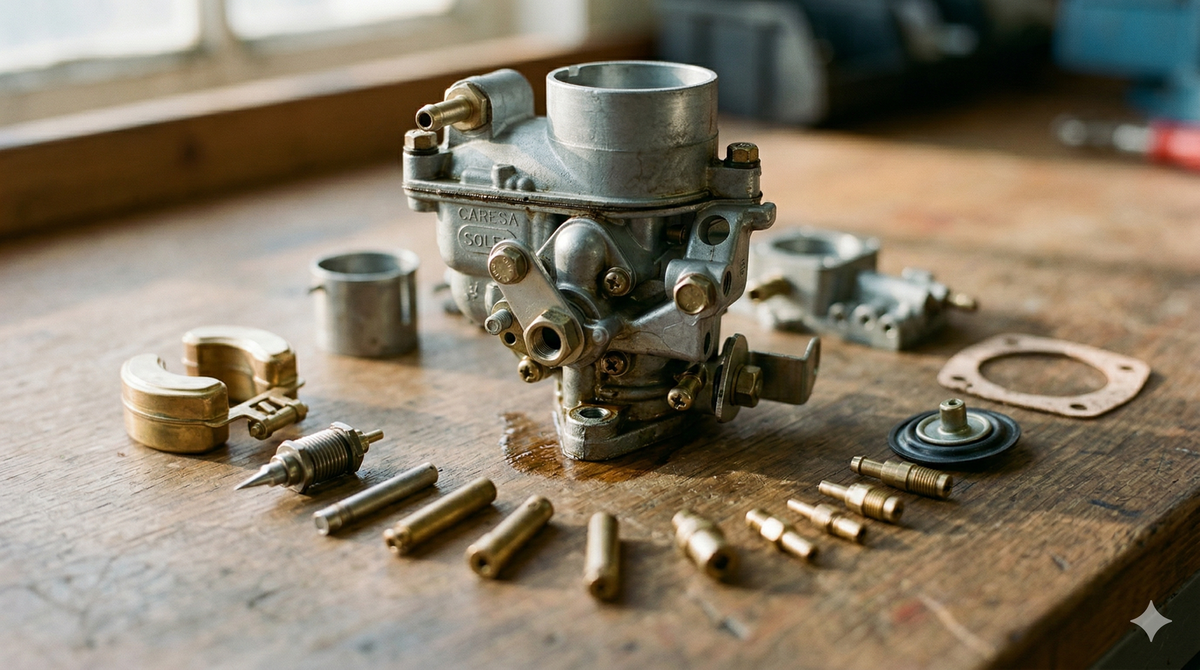
The design philosophy was emphatically functional over elegant. Solex carburettors are not beautiful objects. They are cast aluminium assemblies of moderate precision, slightly agricultural in feel, with float chambers that leak if the needle valve seat wears even slightly and emulsion tubes that clog on anything less than clean fuel. Tuners schooled on Weber or SU equipment frequently found them frustrating - the mixture adjustment range was narrow by sporting standards, and the accelerator pump circuit was not particularly responsive to hot-rodding. You could not easily tune a Solex into something it was never designed to be.
What it was designed to be, it executed remarkably well. The postwar European driver needed a carburettor that forgave poor fuel quality, tolerated years of minimal maintenance, and started on frosty mornings without ritual. Solex delivered all three across an enormous spread of displacements and applications. Its licensing relationship with Mikuni in Japan extended its reach into Asia, and the unit appeared in motorcycles and industrial engines as well as cars, a flexibility that speaks to how genuinely universal the core design was.
The criticism that followed the Solex through its career was always the same: adequate, never inspiring. It was the carburettor of engineers who wanted to solve a problem and move on, not of those who wanted to extract the last horsepower from a given displacement. When fuel injection began displacing carburettors in the late 1970s and through the 1980s, the Solex had no particular performance legacy to defend - it simply became unnecessary. The brand passed eventually to Magneti Marelli, its name surviving mostly in the memories of classic car restorers hunting correct-specification rebuilds for concours-correct Beetles and 2CVs.
That is, perhaps, the most honest verdict on the Solex: it was indispensable for exactly as long as indispensability mattered, and unremarkable in precisely the way that made it ubiquitous. Postwar Europe didn't need a carburettor with racing ambitions. It needed one that just worked. Solex understood the assignment before anyone had written it down.