The Rolls-Royce–Bentley L Series V8
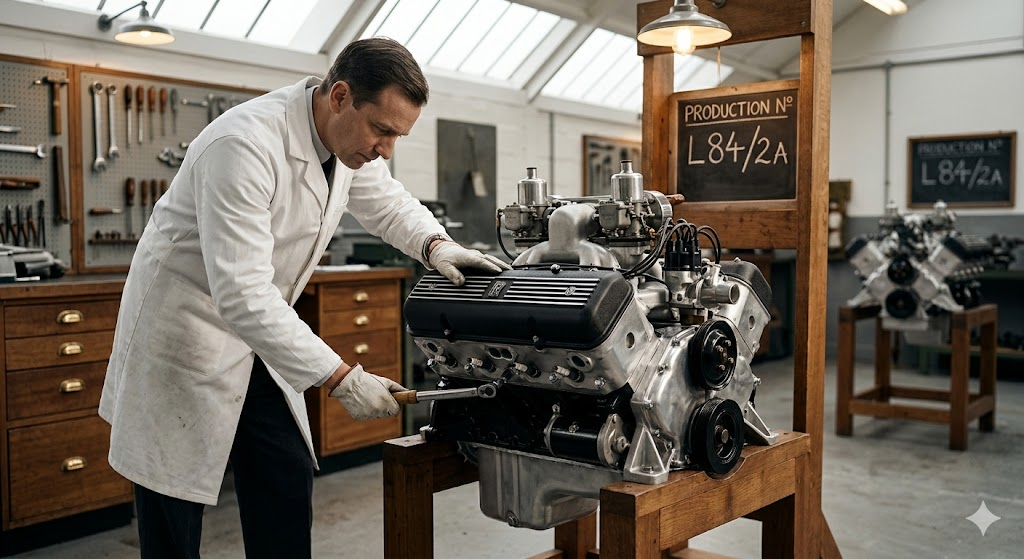
Rolls-Royce never told anyone how powerful it was. Not in 1959, when it first appeared beneath the bonnet of the Silver Cloud II and Bentley S2, and not decades later when it was still turning out cars under entirely different ownership structures. The official position - that power output was "adequate" - was maintained with a straight face through the entire production life of one of the most durable engine families the automotive world has ever produced. That the L Series V8 ran from 1959 to 2020, through sixty-one years and more corporate transformations than most engineers live to see, suggests that whatever Crewe's designers built in the late 1950s, adequate was a significant understatement.
The engine that debuted in 1959 displaced 6,231cc from a 90-degree V8 architecture, with both the cylinder block and cylinder heads cast entirely in aluminium alloy - a specification that was genuinely adventurous for a British manufacturer of that era, most of whom were still committed to iron construction. The bore and stroke were 104.1mm and 91.4mm respectively, the compression ratio sat at 8:1, and twin SU HD6 carburettors fed a pushrod overhead-valve configuration with wedge-shaped combustion chambers. The output was estimated by independent analysts at around 185 brake horsepower at 4,000rpm, with 460Nm of torque available at a lazy 2,200rpm - figures that made the engine's essential character immediately clear. This was not a unit designed to rev with enthusiasm. It was designed to pull with authority, quietly, from very low in the range, and to do so without drama or announcement for as long as the owner required.
The aluminium construction prompted persistent rumours - never officially confirmed or denied - of American influence, specifically from Chrysler's contemporary V8 programmes, which had similarly embraced light-alloy construction. Rolls-Royce maintained with characteristic firmness that the engine was an entirely in-house Crewe design, and the evidence available supports their position more than it undermines it, though the timing of the two programmes was close enough to keep the speculation alive in enthusiast circles for decades.
The first significant development came in 1970, when the stroke was lengthened through a redesigned crankshaft to produce the definitive 6,750cc displacement - the figure that would remain standard through the remainder of the engine's life. The Silver Shadow received this enlarged unit first, and the improvement in real-world tractability was immediately apparent to road testers, who noted that the already generous torque characteristics had become almost overwhelming at normal road speeds. The power output, still officially unquoted, was estimated at somewhere above 200 brake horsepower, which in the context of the Silver Shadow's monocoque bodyshell represented a genuine performance step.
What followed was not revolution but continuous, considered evolution - the engineering equivalent of adding pages to a book rather than writing a new one. The Silver Spirit and Silver Spur of 1980 inherited the platform and the engine, tweaking compression ratios and intake geometry while the fundamental architecture remained unchanged. Fuel injection eventually replaced the carburettors. Electronic management systems arrived. Emissions equipment was grafted on with varying degrees of elegance. Through the Bentley Turbo R and Arnage phases, the engine gained forced induction and power outputs that would have been unthinkable to its original designers, who had built it to murmur rather than roar. The Bentley Mulsanne, which carried the engine in its final years before production ended in 2020, was producing over 500 brake horsepower from the same basic architecture that had delivered 185 in 1959.
The genuine strengths of the L Series were not headline performance but structural integrity and mechanical generosity. Built by hand over the course of approximately a week at Crewe, the engines were assembled with a degree of care that production-line manufacturing cannot replicate, and properly maintained examples regularly exceeded 500,000 miles without requiring a rebuild - a figure that no contemporary competitor could match and that most modern engineers would greet with frank disbelief. The aluminium construction kept weight reasonable, the pushrod configuration kept the engine compact enough to fit within evolving body architectures, and the fundamental conservatism of the design - two valves per cylinder, no variable timing, no exotic materials - meant that when something did eventually wear, a skilled engineer could address it without a computer diagnosis.
The drawbacks were inseparable from these same virtues. The pushrod, two-valve architecture that made the engine so robust also meant it was always leaving performance on the table relative to what double-overhead-cam, multi-valve competition could achieve from the same displacement. Fuel consumption was, throughout the engine's life, a conversation best avoided entirely - not because the figures were embarrassing by the standards of the class, but because the standards of the class were themselves hard to defend in any era of fuel consciousness. And the very longevity that makes the L Series remarkable also meant that Rolls-Royce and Bentley were, for decades, powering their cars with an architecture designed before the Beatles released their first single. Whether that represented admirable continuity or engineering inertia was a question the two marques preferred not to engage with directly.
The cultural significance of the engine lies precisely in its invisibility. Unlike the engines that made Ferraris or Porsches famous - units celebrated, photographed, and discussed in their own right - the L Series existed to be unfelt as much as felt, to compress distance without drawing attention to the mechanism doing the compressing. It was the engine as butler: present at all times, never noticed unless absent, and deeply, almost aggressively unpretentious about the extraordinary competence it was quietly exercising on the occupants' behalf. That it lasted sixty-one years in production, outliving the entire era that produced it, is not an accident of inertia. It is the consequence of having got something fundamentally right at the first attempt - and of having the patience, and the institutional confidence, never to feel the need to say so.