The Kensington Motor Show Circuit and Boutique British Marques
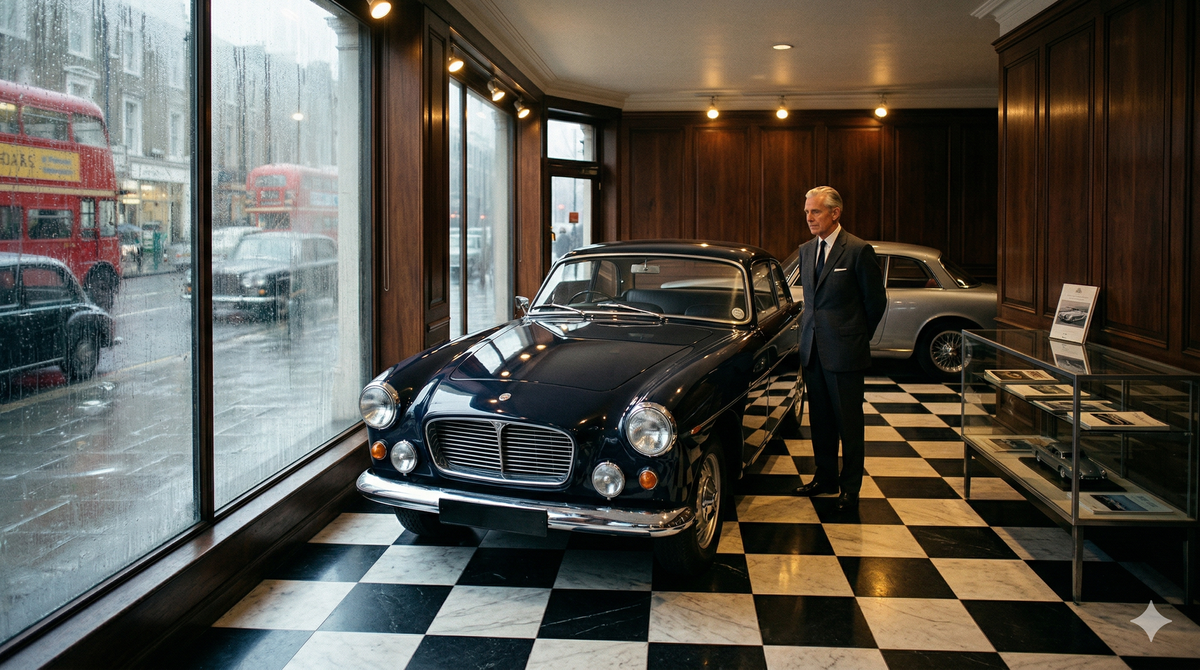
The peculiar genius of London's boutique British motor trade in its postwar golden age was that it treated the act of selling cars as a minor inconvenience to the business of maintaining standards. On Kensington High Street, at Piccadilly, along the fringes of Mayfair, a loose constellation of small, fiercely independent marques operated showrooms that bore no resemblance to the volume-trade forecourts multiplying across the rest of Britain. You did not browse. You arrived, often by introduction, and the proprietor - sometimes the proprietor who also happened to be a racing driver, or an engineer, or both - decided whether the transaction was worth conducting.
Bristol was the most extreme expression of this mode. Tony Crook ran his Kensington High Street corner with the calm authority of a man who understood that scarcity, properly managed, was its own form of advertising. Alvis, operating from Piccadilly showrooms and selling cars built in Coventry to coachbuilder designs approved by the Swiss firm Hermann Graber, operated with similar hauteur. Jensen, pitching from West Bromwich into the London luxury market, occupied the slightly more accessible tier - still bespoke, still hand-built, but willing to place advertisements in The Autocar rather than relying entirely on word of mouth.
What united these marques was a shared refusal to compete on volume. At the Earls Court Motor Show - held annually at the great hall in Kensington from 1937 through the postwar decades - they occupied stands that felt like islands of considered calm amid the bright lighting and crowd noise of the mass market. The Bristol 406 appearing at the 1957 show, the Alvis TE21 at 1963, Jensen's C-V8 in 1963 with its enormous 6.3-litre Chrysler unit: each represented a kind of counter-programming to the Ford Anglia and the BMC 1100 that dominated headlines and floor space. The boutique marques were never going to outsell Dagenham. They weren't trying to. They were making an argument about what a car could be for a person who understood the difference between transport and an instrument of life.
Technically, the approach varied. Bristol brought genuine aerospace discipline - wind-tunnel-tested bodies, aircraft-standard construction tolerances, a meticulous approach to aerodynamic drag that genuinely distinguished their cars from heavier, less considered rivals. Alvis relied on the Graber coachwork relationship to produce bodies of conservative Swiss-influenced elegance, their engines developed in-house until the economics of low volume made that increasingly difficult to sustain. Jensen pursued something different again: early adoption of American V8 power married to an in-house body, culminating in the Jensen FF of 1966 - a car that introduced four-wheel drive and anti-lock braking to a production saloon for the first time in history, a technical achievement that arrived almost without fanfare and was ignored by most of the industry for another decade.
The drawbacks of this entire category were structural rather than incidental. Hand assembly without modern quality control produced fitment that varied. Supplier dependency on American drivetrain components - Bristol and Jensen both leaning heavily on Chrysler for engines and transmissions - created a logical inconsistency at the heart of the British character these cars claimed to embody. And the commercial model was fragile in a way that Crook's imperious Kensington manner could not indefinitely conceal: Alvis built its last car in 1967 when Rover acquired the company and shelved the car programme entirely, Jensen collapsed in the mid-seventies under economic pressure, and Bristol survived into the twenty-first century only through a combination of remarkable owner loyalty and the kind of commercial insularity that amounted, in the end, to its own survival strategy.
What the Earls Court shows of the late 1950s and 1960s captured, in retrospect, was the last moment when this circuit of boutique British marques could credibly pretend that it would endure. The motor shows gave them visibility; Kensington and Piccadilly gave them address; the clientele - the surgeons and lawyers and industrialists who kept coming back - gave them purpose. When that clientele began encountering equally bespoke offerings from Stuttgart and Maranello, the argument became harder to sustain. The boutique British circuit did not end with a bang but with a gradual dispersal, the showrooms going dark one by one, the cars they had sold becoming the concerns of collectors rather than drivers, the neon over the Bristol showroom among the last to stay lit.