The Jaguar C-Type and D-Type Racing Programme
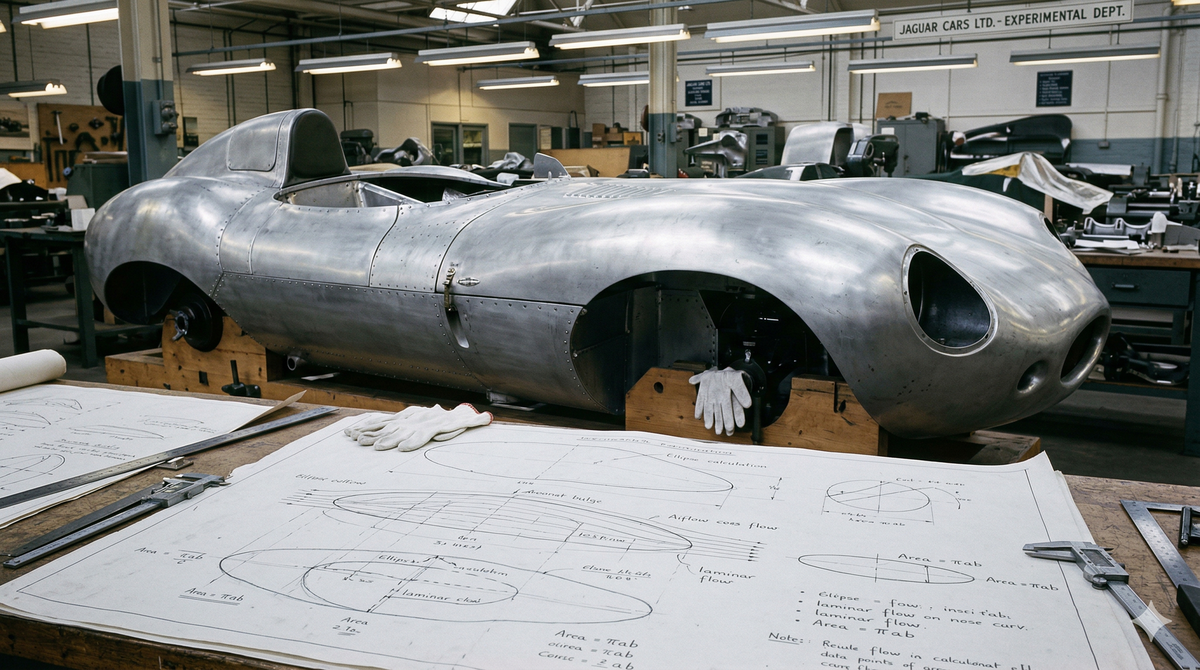
When Malcolm Sayer tilted the XK straight-six eight and a half degrees from vertical inside the D-Type's engine bay, the resulting asymmetric bonnet bulge became one of the most honest pieces of bodywork in racing history - a direct external signature of an internal engineering decision, the aerodynamicist's insistence on minimal frontal area forcing a compromise that the car simply wore on its face. That offset bulge is a small detail, but it encapsulates everything that made the C-Type and D-Type programme extraordinary: a willingness to let engineering logic dictate form, even when form was what the cars were simultaneously celebrated for.
The programme began not with grand ambition but with a practical observation. After three standard XK120s made an exploratory visit to Le Mans in 1950, William Heynes and team manager Lofty England persuaded Lyons that a purpose-built car could win outright if weight and aerodynamics were properly addressed. Malcolm Sayer, who had arrived from the Bristol Aeroplane Company carrying an aeronautical engineer's instincts, shaped the C-Type's fluid aluminium bodywork using aircraft industry methodology - actual mathematical calculation of airflow rather than the intuitive clay-modelling that characterised most contemporary competition car design. The result was a car that weighed roughly twenty-five percent less than the XK120 it derived from, and which took Le Mans on its first attempt in 1951, Peter Walker and Peter Whitehead leading home with a nine-lap advantage.
The 1952 race was a disaster. Jaguar's modified C-Type bodywork, intended to be more aerodynamically efficient, overheated the engine by restricting airflow to the radiator, and all three works cars retired. The lesson was absorbed without theatrics: for 1953 Jaguar reverted to the original body profile, lightened the panels, and deployed the Dunlop disc brakes that had been under development for two seasons. Tony Rolt and Duncan Hamilton won at over 100mph average - the first time in Le Mans history that figure had been achieved - and the disc-equipped C-Types could brake so far past where their drum-equipped rivals began decelerating that competitors could observe the advantage with dismay from their own cockpits.
The D-Type that followed in 1954 represents one of the most significant structural departures in racing car history up to that point. Sayer's central monocoque tub - elliptical in cross-section, constructed from aluminium alloy sheets, with the driver essentially sitting inside the stressed-skin structure itself - borrowed directly from aircraft fuselage engineering. The engine subframe bolted to the front bulkhead, the suspension to the rear; there was no separate chassis in any conventional sense. Sayer also specified a deformable Marston Aviation bag fuel tank in place of a conventional metal vessel, another aeronautical application entirely without precedent in mainstream competition car design. The fin mounted behind the driver's headrest, which has become the D-Type's most immediately recognisable visual signature, was a functional aerodynamic stability device for the Mulsanne Straight rather than an aesthetic gesture - though Sayer's calculations had produced something that happened to look magnificent.
The D-Type won Le Mans in 1955, 1956, and 1957, achieving 172.8mph on the Mulsanne Straight against Ferrari's 160.1mph despite no meaningful engine power advantage - the aerodynamic and structural efficiency was simply generating more top speed from equivalent horsepower. The 1955 victory was shadowed permanently by the catastrophic accident involving a Mercedes-Benz that killed more than eighty spectators - a tragedy that prompted Mercedes to withdraw from racing entirely and altered the competitive landscape that the D-Type had been built to navigate. Jaguar's own works withdrawal at the end of 1956 left the 1957 victory to the Ecurie Ecosse privateer team, which remains one of the more poignant footnotes in Le Mans history: the car winning its final race without its creator present to see it.
What the programme left behind extended far beyond the trophy cabinet. The monocoque construction philosophy that Sayer demonstrated with the D-Type became the structural language of Formula One within a decade and of virtually every serious racing car thereafter. The disc brake technology proved at Le Mans in 1953 migrated to road cars before the decade was out. And the E-Type - Sayer's next project - carried the aerodynamic and structural thinking of the D-Type directly into a road car that the world decided was beautiful, largely because the mathematics that had made the racing cars fast generated, as a byproduct, shapes of extraordinary elegance. The C-Type and D-Type programme was never simply a racing exercise. It was a five-year aeronautical engineering course conducted at racing speeds, and Jaguar's road car reputation for the following two decades was built almost entirely on what was learned there.