The Bremen Senate Insolvency and the End of Borgward
The most damning detail in the entire Borgward affair is not the bankruptcy itself - it is what happened after. When the liquidators finally settled the group's accounts, every creditor was paid in full, and DM 4.5 million remained. A company allegedly destroyed by insolvency had, in fact, been solvent. What collapsed in Bremen in 1961 was not a business beyond saving - it was a business that powerful men decided should not be saved.
The sequence of events leading to that conclusion began not in a courtroom or a bank but on the cover of Der Spiegel. The issue of 14 December 1960 carried Carl Borgward's face - cigar in mouth, the image of the self-made industrialist - alongside reporting that was sharply and, by later assessment, selectively critical of his financial management. Within days, the mass-market Bild newspaper and television bulletins amplified the same narrative. The coordinated quality of that media pressure, arriving simultaneously across multiple outlets, has never been fully explained.
What followed moved quickly. Borgward approached the local Landesbank at the end of December 1960 for a further DM one million in credit, requesting a guarantee from the Bremen Senate. The senators initially agreed - then reversed course as the press campaign intensified. At a thirteen-hour meeting in February 1961, Borgward was forced to pledge the entire company to the state in exchange for the guarantee he needed. He signed. The Senate then appointed its own man to chair the supervisory board: Johannes Semler, a lawyer, former Bundestag member, founding figure of the CSU, and a man with deep roots in the Bavarian political establishment - including connections that likely reached as far as Ludwig Erhard, who would become German Chancellor two years later. The appointment of a Bavarian political operative to oversee a Bremen manufacturer was, at minimum, an unusual choice.
Semler initiated a Vergleichsverfahren - a court-sanctioned restructuring procedure - in July 1961. It should have allowed the group to trade through its difficulties while protecting creditors. Instead, within two months, the Borgward and Goliath companies were declared bankrupt outright, followed in November by Lloyd. The restructuring, in retrospect, appears never to have been seriously pursued. Whether Semler acted on instruction, on political instinct, or purely on his own judgment has never been established in any formal proceeding.
Borgward's own culpability is real and should not be minimised. He was financially naive on a spectacular scale - by autumn 1960 he was holding unpaid supplier invoices worth more than DM 100 million for sheet metal and tyres alone, preferring to delay payment rather than engage properly with bank financing. His finance director's advice had been consistently ignored. The Der Spiegel retrospective of 1966 concluded that with modest additional support and a greater willingness to take counsel, the 1961 crisis was entirely survivable. The company did not need to die. It was allowed to die, and there is a difference.
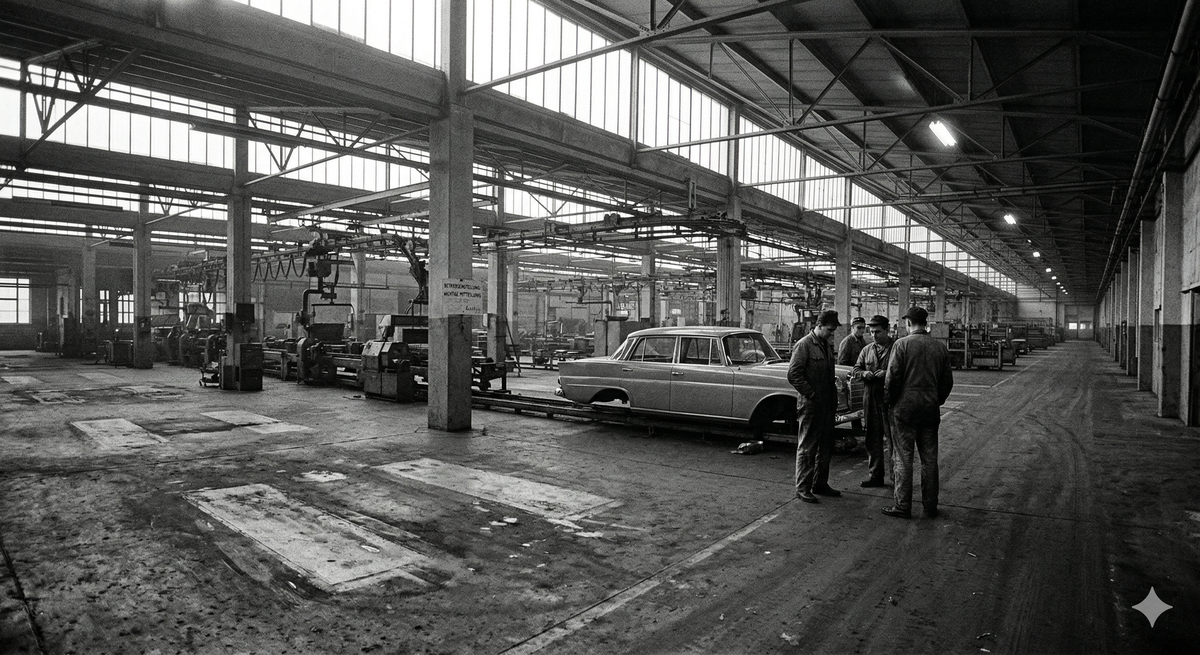
Twenty thousand workers lost their jobs in Bremen. The factories were dismantled. The tooling for the Isabella and the P100 was dispersed or scrapped. Carl Borgward died of a heart attack in July 1963, still publicly insisting on the company's fundamental solvency. He was seventy-two, and he was right.
The Borgward insolvency became a case study in how political, financial, and media power can converge on a single industrial target in ways that are individually deniable but collectively devastating. Germany's postwar economic miracle was supposed to protect exactly this kind of independently built enterprise. What the Bremen affair demonstrated instead was the miracle's less celebrated feature: the established order could still reach into a working factory and quietly close the lights - and then walk away with clean hands while the creditors collected their money in full.