Postwar German Mid-Market Cars - Opel, Ford, and the Gap Borgward Filled
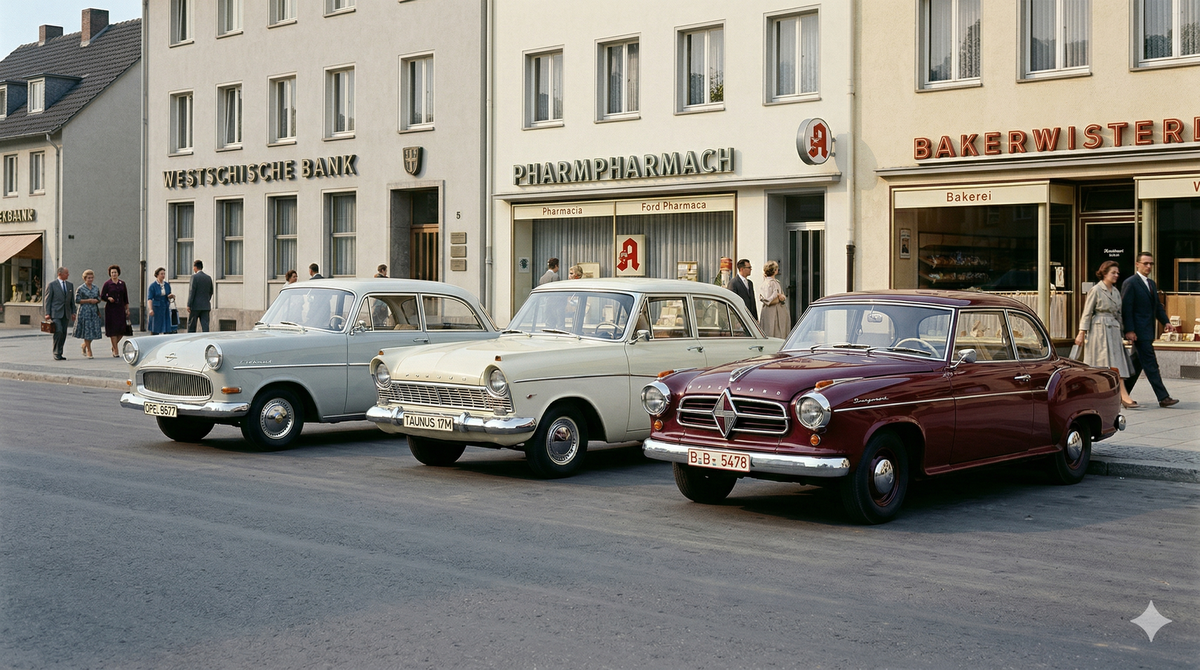
When the Opel Rekord arrived in 1953, it was already two years behind the car that had shown it what to do. The Borgward Hansa 1500 of 1949 had introduced the three-box ponton body to Germany - flush sides, integrated fenders, a clean postwar silhouette - before General Motors in Rüsselsheim had managed to shed the pre-war shapes it was still selling. That sequence matters, because the story of postwar Germany's mid-market is usually told as a contest between two American-owned giants and the plucky independents circling them, when the truth is almost the reverse: the independents were leading, and the giants were catching up.
The market itself was structured by the Wirtschaftswunder in ways that rewarded the middle ground almost more than any other segment. Volkswagen held roughly 27 to 30 percent of the German market through the late 1950s with a single model - the Beetle - that sat at the lower edge of the true family car bracket. Mercedes occupied the upper reaches. Between them lay an enormous space: the aspirational salaried worker, the small business owner, the professional who needed a real four-door with a proper boot and enough engine to sustain Autobahn speeds, but who could not yet stretch to a Stuttgart price list. Opel and Ford both understood this space. Neither moved into it with particular urgency until the competition forced their hand.
Opel's answer was the Rekord, which by 1959 was selling 135,530 units annually and holding close to 15 percent of the entire German market. It was a competent, rationally engineered saloon - General Motors' considerable manufacturing infrastructure in Rüsselsheim producing reliable volume at accessible prices. The Rekord's strength was consistency rather than flair: each successive iteration between 1953 and the early 1960s grew slightly more refined without taking many risks. Ford Germany's Taunus 12M and 15M competed from Cologne, sharing nearly every component across the two model lines and achieving a kind of pragmatic volume efficiency that the accountants admired more than the customers did. When Ford launched the 17M in 1957 - flamboyantly styled by American standards, tail fins and all - it was explicitly positioned against the Opel and, specifically, against the Borgward Isabella, which had by then acquired something approaching iconic status in the segment.
That is the telling detail. Ford's product planners named the Isabella by name as the benchmark. Not the Rekord. Borgward, with a fraction of the manufacturing resources of either rival, had built the car that defined what the mid-market should feel like. The Isabella's 1.5-litre engine, its torsion-bar front suspension, its chrome-accented bodywork with genuine sweep and proportion - these set the aesthetic and dynamic standard for the class in a way that the competent but uninspiring Rekord never quite matched.
The gap Borgward filled was not purely a market gap. It was a character gap. Opel offered dependable anonymity. Ford offered American styling grafted onto German engineering pragmatism, with variable success. What neither company provided was a car that felt as though its designer had an opinion - a machine with some aspiration to elegance rather than mere adequacy. Borgward's position as the third-largest German manufacturer despite operating without General Motors' capital or Ford's transatlantic backing speaks directly to how acutely the market felt that absence, and how completely the Isabella addressed it.
The irony is that Borgward's collapse in 1961 did not produce a successor to the Isabella. Opel and Ford simply expanded into the vacuum, their volume and distribution networks absorbing the customers who had nowhere else to go. The Rekord grew more sophisticated through the 1960s; the Taunus range diversified. But neither ever quite produced the car that the Isabella had been - which suggests that what Borgward provided was not a product category but a sensibility, and sensibilities, unlike factories, cannot simply be scaled up to fill a gap once the source disappears.