Piero Rivolta and the End of Iso
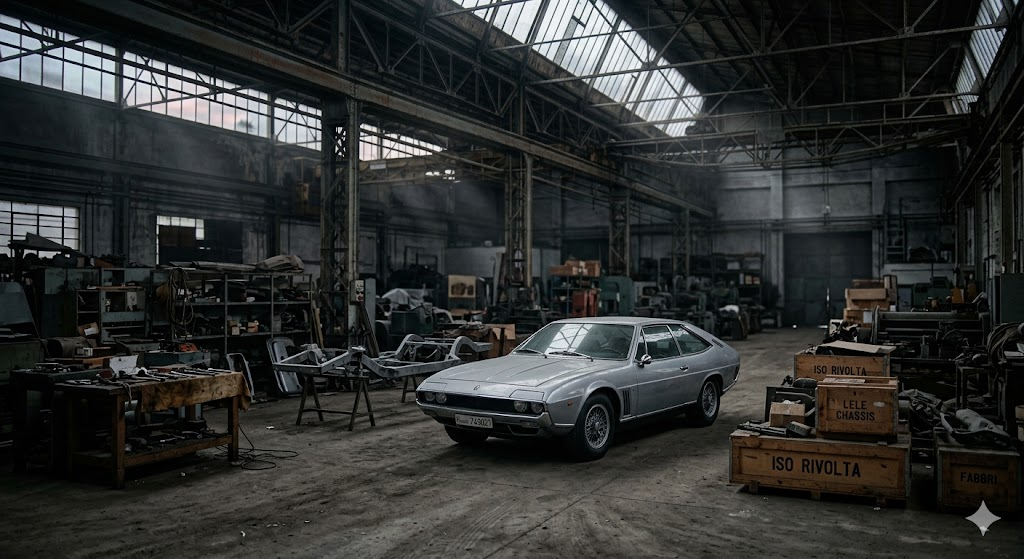
Piero Rivolta inherited a car company the way nobody should inherit anything - suddenly, at twenty-four, in the middle of a product expansion that his father had set in motion and would never see completed. Renzo Rivolta died in 1966 of a heart attack, and the baton passed to a young mechanical engineering PhD whose education was impeccable and whose experience of running an automobile manufacturer was precisely zero. What followed over the next six years was one of the more quietly impressive performances in postwar Italian industry: a young man with no precedent to follow building out a complete model range, commissioning a Formula One programme, and trying to thread Iso through a market that was simultaneously too small for comfort and too competitive for complacency - before a set of external forces arrived that no degree in mechanical engineering could have helped him anticipate.
Under Piero, Iso Rivolta reached its fullest expression as a manufacturer. The Grifo was already in production when Renzo died; Piero oversaw the Fidia four-door saloon, the Lele 2+2, and the compressed, aggressive Varedo. Each model was a coherent extension of the same formula - Italian coachbuilt elegance wrapped around American V8 reliability - but each targeted a slightly different buyer. The Fidia went after chauffeured comfort; the Lele after the Lamborghini Espada's 2+2 GT market; the Varedo attempted a sharper, sportier posture. Together they represented something genuinely ambitious: a complete luxury catalogue from a manufacturer producing fewer than two hundred cars a year. The ambition and the production volume were always in an uncomfortable relationship.
The engine supply crisis of 1972 illustrated the structural precariousness of Iso's position with unusual clarity. General Motors, supplying the Corvette V8 units that underpinned the entire range, demanded advance payment - a standard commercial request that most companies could absorb without drama. Iso couldn't. The pivot to Ford's 351 Cleveland V8 was managed without disaster, and the Ford-powered cars were in several respects the better products, but the episode exposed how thin the financial margins were and how dependent the entire enterprise was on the goodwill of suppliers who had no particular reason to extend it. Piero sold a controlling stake to New York-based Ivo Pera in early 1973, apparently calculating that American capital and the distancing of the Rivolta family from day-to-day financial exposure was a more viable path forward than continued sole ownership. He disagreed with Pera's direction, left the company, and watched from the outside as everything unravelled.
Pera's priority was visibility. He listed the company on the New York Stock Exchange, changed the name to Iso Motors & Co., and pursued the Formula One project - a sponsorship arrangement with Philip Morris that placed the Iso-Marlboro name on the cars of a young team manager named Frank Williams, with drivers Howden Ganley and Nanni Galli. The racing programme was conceived to restore prestige and attract American investors who responded to motorsport marketing. In practice, the cars qualified intermittently, finished rarely, and consumed money that a car manufacturer with an annual output measured in the dozens could not sustainably commit to. It was a classic piece of ambition disconnected from arithmetic.
Then, in October 1973, OPEC cut oil production, and the market for 5.7-litre grand tourers effectively ceased to exist overnight. Industrialised governments imposed highway speed limits, fuel prices spiked, and the entire cohort of low-volume exotic GT manufacturers - Aston Martin, Jensen, Lamborghini, Maserati, Monica, Monteverdi - found themselves simultaneously facing buyer paralysis and collapsing residuals. Iso was the least capitalised of the group and among the first to fall. Production stopped in late 1974. The last car off the line was a Fidia. The Formula One programme, the New York listing, Ivo Pera's investment thesis - none of it survived contact with the reality of a world that had abruptly decided it no longer wanted what Iso was selling.
Piero Rivolta bought back the Iso and Iso Rivolta names from the bankruptcy proceedings. He chose not to restart car manufacturing, declined approaches from larger corporations, and eventually moved to the United States. There is something revealing in that sequence: a man technically capable of rebuilding, possessed of the rights to the name, choosing instead to walk away cleanly. The company he had inherited and then sold had been destroyed not by bad engineering decisions or by designs that failed in the market, but by a geopolitical event and by a new owner whose ambitions outran the company's financial constitution. Piero's record - a complete model range, a coherent brand identity, and a Formula One connection that history now remembers more fondly than contemporaries experienced it - was, in the circumstances, a more considerable achievement than the bankruptcy figures suggest. Iso's story ended not with the crash of poor decisions but with the quiet closure of a chapter that had simply run out of the conditions it needed to survive.