Marcello Gandini - Designer at Bertone
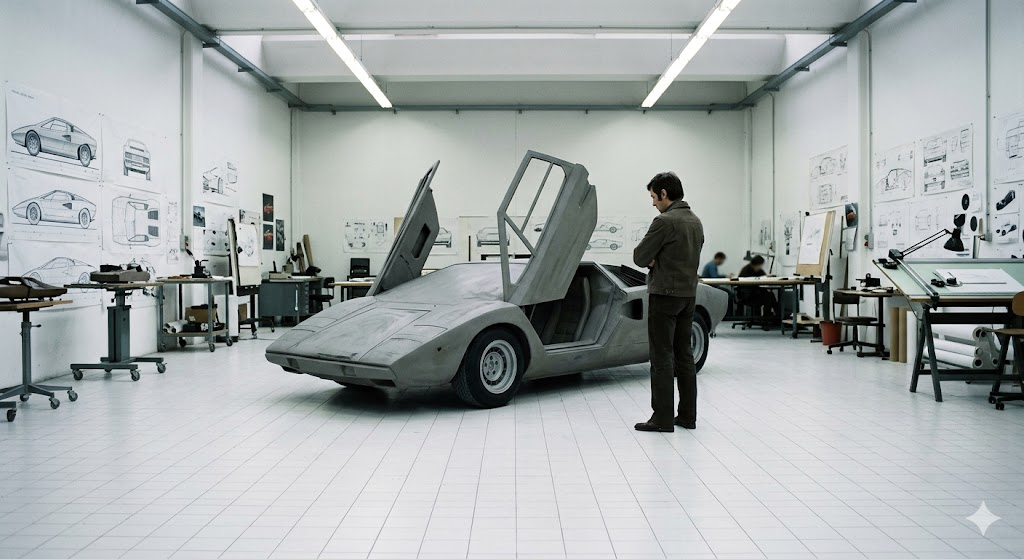
Nuccio Bertone liked to say that he hired talent, not fame. When Giorgetto Giugiaro quit in late 1965, Bertone filled the vacancy with a twenty-seven-year-old who had never designed a production car, had been turned away by the studio two years earlier, and who would - within four months of starting - present the world with the Lamborghini Miura. The audacity of that sequence is almost impossible to overstate. Marcello Gandini didn't arrive at Bertone; he detonated inside it.
The Miura remains the most paradoxical entry point to a career full of paradoxes. Gandini himself was reportedly critical of its aesthetics - too curvaceous, too soft - and yet it was the first car to be called a supercar, with L.J.K. Setright coining the term after encountering it on the Lamborghini stand at Geneva in 1966. The man who designed the blueprint for the modern supercar was simultaneously dissatisfied with it. That restless self-criticism would prove to be the engine of his entire fourteen years at Bertone.
What followed the Miura was not a refinement of its formula but a systematic dismantling of it. The 1968 Alfa Romeo Carabo introduced scissor doors to automotive design - a functional experiment in resolving how a dramatically raked windscreen and a low roofline could coexist with practical entry and exit. The Lancia Stratos Zero of 1970 pushed further still, its windscreen and side glass forming a single seamless semi-ellipse, the driver's entry point a panel lifted from the nose itself. These were not show cars designed to attract camera flashes and then quietly die - they were working propositions, testing ideas that would eventually find their way into production. The Fiat X1/9's transverse mid-engine layout, the Lancia Stratos HF's wedge stance, the Renault 5's compressed practicality - all carry Gandini's fingerprints even when his name doesn't appear on the press release.
The Countach of 1971 is the hinge point of his Bertone career, and the work that defines his aesthetic philosophy most completely. Where the Miura was organic and feminine in its surface tension, the Countach LP500 concept was rectilinear, aggressive, and architecturally severe - every surface a plane, every transition a crease, every corner a decision rather than a compromise. The production version, evolved through the 1970s, is cruder in detail than the prototype but no less committed in intent. Gandini was working through the same visual vocabulary that informed the Maserati Khamsin, the Alfa Romeo Montreal, and the BMW Garmisch: surfaces that looked as though they had been folded rather than sculpted, cars that read as three-dimensional geometry rather than bodywork.
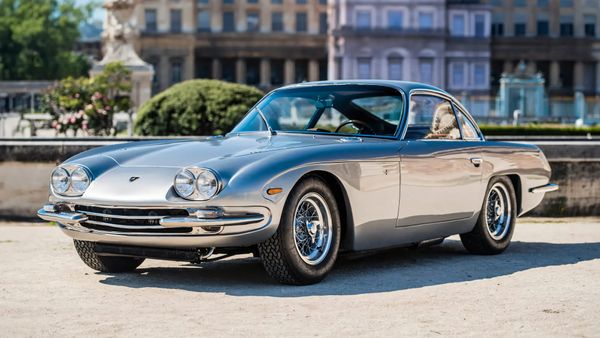
The range within that output is what separates Gandini from designers who found a signature and repeated it. The Iso Rivolta Lele - understated, fastback, deliberately civilised - shares almost nothing visually with the Countach, yet both emerged from the same studio within three years of each other. The Ferrari 308 GT/4, the first mid-engined Ferrari 2+2, is another Gandini Bertone design that receives insufficient credit - precisely because it sits so far from the extremes he was simultaneously producing for Lamborghini. The first-generation Volkswagen Polo and the Citroën BX are Gandini designs. The man who frightened the automotive establishment with the Countach also designed the car that taught Europe's middle class what a practical hatchback could look like.
The criticisms of his work are real and worth stating directly. The Espada, however dramatic, is visually ungainly from certain angles - a function of packaging a genuine four-seat cabin into a body that wanted to be a two-seater. Some of his more extreme concept work, particularly the Bravo and the Sibilo, prioritised visual provocation over any coherent human proposition. His later independent career - the Bugatti EB110 prototype, the Cizeta-Moroder V16T - was commercially disappointing, and the Diablo episode, in which Lamborghini substantially revised his original design brief before production, was a professional humiliation he never entirely concealed.
None of that diminishes the weight of the Bertone years. Gandini was not a designer who happened to produce remarkable work; he was a designer who changed the visual grammar of an entire field in the course of a single decade, working simultaneously in the register of mass-market economy cars and hand-built supercars without compromising in either direction. He died in March 2024, aged eighty-five, still in Turin, still the same reserved, privately critical figure who had apparently always found the Miura slightly too pretty. The industry lost him before it had properly finished arguing about him - which, given his career, seems exactly right.