Jaguar XK Engine - Engineering History
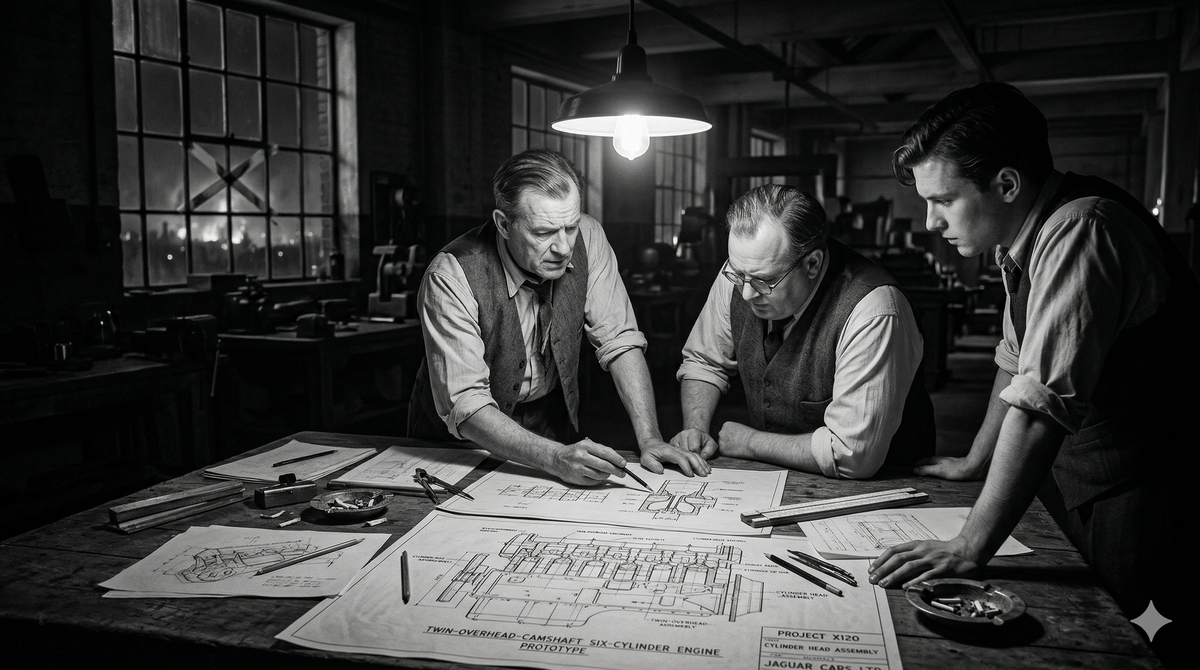
The fire watch shifts during the Coventry Blitz are among the more unusual origin stories in engineering history - a handful of men standing on the roof of a blacked-out factory, scanning the night sky for incendiary bombs, talking their way toward a twin-cam six-cylinder that would still be winning Le Mans a decade later. William Heynes, Walter Hassan, and Claude Bailey were Jaguar's engineering nucleus, and the conversations that began during those wartime vigils at the Foleshill Road factory from around 1942 onwards produced the design brief for the XK: a high-output, long-lived, production-viable twin-overhead-camshaft straight-six that could anchor the company's products for years without fundamental revision. That ambition was not modest. It was also, against most reasonable expectations, entirely fulfilled.
The twin-cam layout that Heynes and his team settled on was, for a mass-production engine in the mid-1940s, a genuine statement of intent. Alfa Romeo and Bugatti had employed twin overhead camshafts in racing machinery, but those were exotic, hand-built, and priced accordingly. The XK's DOHC architecture, with its hemispherical combustion chambers and carefully developed chain drive, was intended from the outset to go into saloon cars - the Mark VII was always the planned recipient - at prices ordinary professional buyers could approach. The 3.4-litre dimensions of 83mm bore and 106mm stroke were considered by engineers close to the project as the engine's natural, definitive form; all subsequent variants represented compromises imposed by circumstance.
Those variants were numerous. The 2.4-litre unit, fitted to the compact saloon range from 1955, shortened the stroke considerably and produced an engine that felt somewhat throttled in character compared to the open-breathing 3.4. The 3.8-litre, introduced for 1959, stretched the bore to 87mm and delivered improved torque that suited the heavier XK150 and the Mark IX saloon, though it required a new block to manage the stresses of the wider bore spacing. The 4.2-litre of 1964 - the unit that powered the E-Type Series 1 through its most celebrated years - brought further displacement through a longer stroke, and came with a fully synchronised Jaguar-designed gearbox at last replacing the long-suffering Moss unit; it is generally considered the most balanced XK variant for road use. And then there was the straight-port head, introduced on the S models and derived directly from the C-Type competition programme, which transformed the engine's upper-rev character through wider valve angles and improved gas flow - the version that made a 3.4 S capable of a genuine 130mph when such a figure still commanded serious respect.
The engineering elegance of the XK is inseparable from its longevity, and yet longevity is also where honest assessment must apply some pressure. The engine that began production in 1949 and ran, in increasingly modified form, until 1992 was not the same engine at the end as it was at the beginning - and not always in ways that served it. The crankshaft sludge traps, which collected debris in blind drillings, represent the kind of detail that haunts long-lived designs: harmless in regular use but a slow accumulation of risk in engines that are not meticulously maintained. The manual adjustment required on the upper timing chain was an accepted inconvenience throughout production. Emissions regulations in the 1970s imposed twin Zenith-Stromberg carburettors on US-market cars in place of the SUs, with a measurable and sometimes painful loss of output - a 4.2-litre producing 170bhp by some DIN net measurements where the early unit had claimed 265 in full S specification. The XK's last years in the XJ6 were a long diminuendo.
What redeems the full picture is what the engine represented at its best and what it made possible. The Le Mans victories of 1951, 1953, 1955, 1956, and 1957 were built on XK foundations, the C-Type and D-Type racers exploiting the architecture's fundamental soundness and the straight-port head's breathing capability with each successive season. The E-Type's 1961 debut placed a 3.8 XK beneath a bonnet so beautiful that the engine's own considerable merits were somewhat obscured by the bodywork - but the performance figures that earned the car its reputation were the engine's contribution, not merely the aerodynamics. For the better part of fifteen years, the XK produced more power per pound of purchase price than almost anything else a buyer could reasonably consider.
When Jaguar finally retired it in favour of the AJ6 - itself carrying forward the XK's head-clamping philosophy in its block architecture - the engineering press acknowledged a passing without much sentimentality. The XK had stayed too long, its reputation slightly worn by the compromises of its final decade. But the engine that was sketched out on a factory rooftop during an air raid, refined into production in a country still rationing food, and then driven to five Le Mans victories, remains one of the most consequential pieces of engineering in British industrial history - not because it was perfect, but because it was right for long enough to matter enormously.