Hooper & Co. Coachbuilders
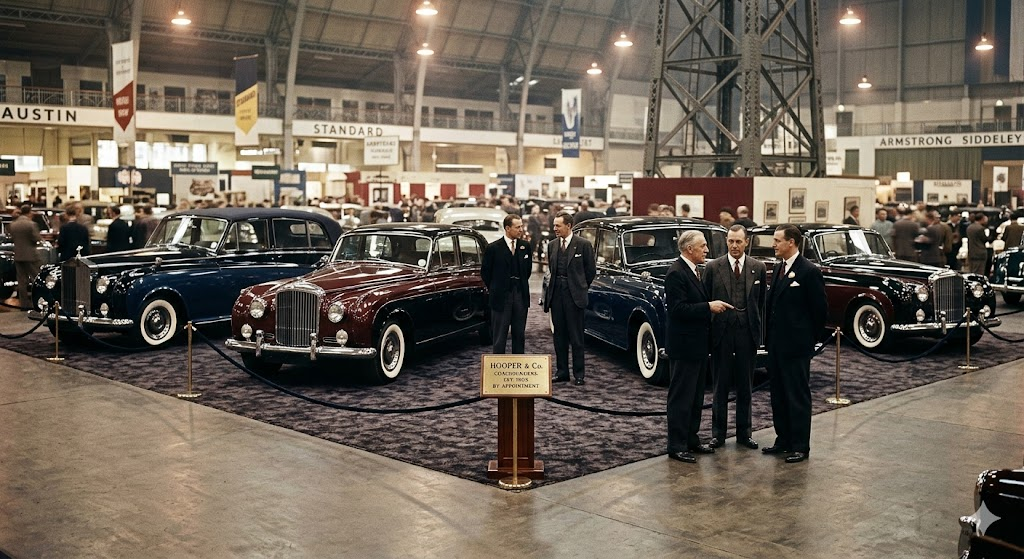
At the 1959 Earls Court Motor Show, Hooper & Co. stood their final exhibit - four cars on the stand, including a Bentley S2 built on the very first S2 Continental chassis to leave Crewe. It was body number 10294, the last bespoke coachwork the firm would ever complete. The stand was not a celebration. It was a wake, attended by the finest craftsmen in Britain, dressed in their best, for an industry that the monocoque body shell had quietly made redundant.
That Hooper's century and a half should end at a motor show rather than in a fire or a bankruptcy says something essential about the firm's character. Founded as Adams and Hooper in 1805 in London's Haymarket, they did not collapse - they simply became unnecessary, which is both a more dignified and a more melancholy exit. From the beginning, the operation was geared towards clients for whom money was a context rather than a constraint. They held the Royal Warrant from 1830 through an unbroken sequence of reigns, building horse-drawn carriages for William IV, Victoria, and Edward VII before the motor car arrived to complicate everything. Their first royal automobile body went onto a Daimler chassis and was delivered to Sandringham in March 1900, painted in the chocolate brown and red-lined livery the royal family would use well into the following decades.
The transition from horse-drawn coachwork to motor bodies was made with the kind of confident adaptability that only deep craft knowledge enables. By the 1930s, Hooper was bodying Rolls-Royces and Daimlers for clients whose social circles barely overlapped with the general public. When the Depression thinned the field of British coachbuilders catastrophically, Hooper not only survived but expanded, opening a second factory in Acton, West London, and turning out over 300 bodies in 1936 alone - their best year. In 1938, they absorbed the rival coachbuilder Barker, which had fallen into receivership, adding that firm's heritage to their own. By 1940, Daimler - and through it, the BSA group - had acquired Hooper, an arrangement that gave the firm industrial backing without noticeably diluting the work coming out of Chelsea.
What Hooper produced in their motor car years was distinguished above all by restraint and formality rather than flamboyance. Their bodies were stately, weighted with the same sense of occasion that their horse-drawn carriages had always carried - the kind of work where no detail was ornamental unless it was also correct. Aluminium had entered their construction repertoire as early as 1933, allowing the sculptural shaping of wing and door surfaces that wood-framed bodywork could not achieve with the same fluency. The 1951 Rolls-Royce Wraith with the Perspex-topped roof became one of the more startling one-off Hooper designs of the post-war era, demonstrating that the house could stretch to theatre without losing its composure. More typically, their Silver Cloud and Bentley S-series bodies were essays in controlled grandeur - elongated proportions, razor-edged rear quarters, rooflines that swept with the unhurried confidence of a firm that had been doing this since before Rolls-Royce existed.
The quality of their craftsmanship was never seriously disputed. What was occasionally noted, with varying degrees of tact, was that Hooper's designs aged into conservatism - that the house tended to lead with formality and follow with innovation rather than the reverse. Against H.J. Mulliner's Flying Spur or Park Ward's drophead creations, Hooper's saloon bodies could read as sombre where competitors read as elegant. This was not an engineering failure but a philosophical one: Hooper built for clients who expected their motorcar to feel like a continuation of everything they already owned, and who did not wish to be surprised by it. The firm knew its audience with forensic precision, and served it accordingly.
The Sopwith Camel interlude during the First World War - when Hooper produced the famous fighter aircraft at three per day - sits as one of the stranger footnotes in coachbuilding history, a reminder that the skills of forming metal and wood into aerodynamically considered shapes translate across domains in ways that specialists rarely anticipate. With peace restored, the tools went back to building motor bodies as though the whole episode had been a minor inconvenience.
When Rolls-Royce informed Hooper in 1958 that the Silver Cloud's successor would be built as a monocoque - chassis and body integrated, no separate rolling frame to send to an outside coachbuilder - the game was simply over. The decision was rational, inevitable, and completely fatal to Hooper's core business. The St. James's Street showroom closed in September 1958. The Earls Court stand the following year was their farewell performance, conducted with characteristic dignity and no fuss.
The legacy is one of civilised excellence in a tradition that the modern motor industry has replaced with personalisation programmes and bespoke divisions that approximate the same results with considerably less artistry. Royal patronage through nine reigns, a century and a half of uninterrupted craft practice, a body number that ran to 10,294, and the last car they ever built sitting on the first chassis of the very model that marked the end - it is difficult to imagine a more complete ending. Hooper did not go out fighting progress. They simply bowed, picked up their tools, and left the room.