Grand Touring - The Concept and Its Origins
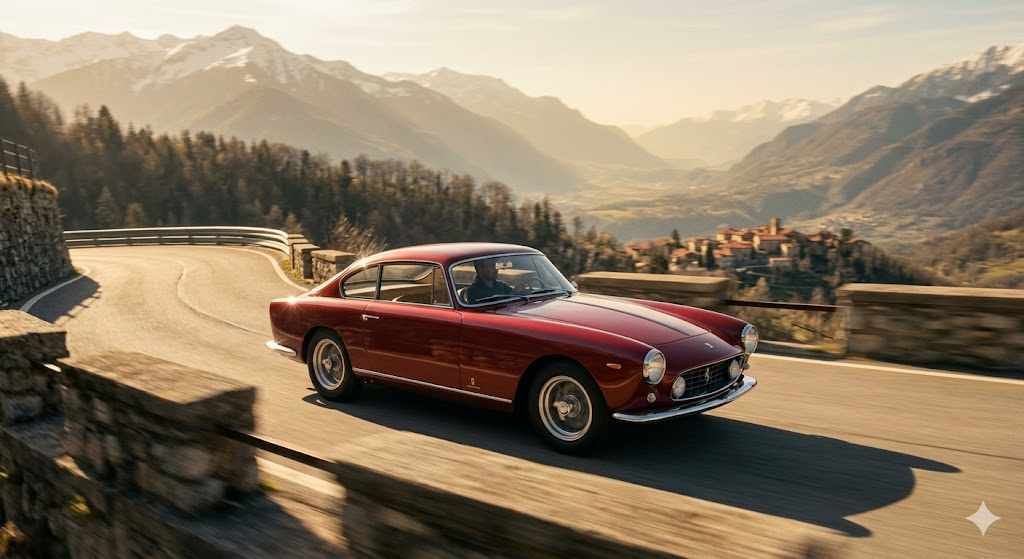
Before the motor car existed to carry it, the idea had already been alive for two centuries - in silk-upholstered carriages jolting south through the Mont Cenis Pass, in the bags of young English aristocrats packed for Rome, Florence, and Venice, in the civilised assumption that covering great distances with intelligence and comfort was itself a form of education. When the term gran turismo eventually migrated onto Italian coachwork and engine specifications in the early twentieth century, it wasn't coining a new concept. It was claiming an inheritance.
The phrase entered automotive vocabulary properly in 1930, when Alfa Romeo badged its dual-overhead-cam 6C 1750 as Gran Turismo - a deliberate signal that this was a car designed not for circuit racing alone, nor for Sunday errands, but for the sustained, rapid crossing of real geography. What separated it from a sports car was precisely the word "touring": the implication of luggage, of overnight stops, of a destination worth arriving at. The distinction sounds obvious now, but it required a car that could be simultaneously fast enough to make the journey thrilling and composed enough to make it bearable - a harder engineering brief than either the racing car or the tourer alone.
The concept crystallised definitively at the 1951 Turin Motor Show, when Lancia unveiled the Aurelia B20 GT - a Pininfarina-bodied coupé whose design, overseen by Vittorio Jano, resolved the tension between performance and refinement at a stroke. The B20 was genuinely fast, with its 2.0-litre V6 mounted at the rear of the engine bay for better weight distribution, and it possessed the kind of composed long-distance manners that no purely sporting car of the period could match. Enzo Ferrari took notice. Johnny Lurani, the Italian racing driver and historian, took notes. The template was established.
What followed was perhaps the most fertile decade in automotive history for the GT concept. Ferrari's 250 series - particularly the 250 GT Berlinetta Lusso - embodied the philosophy in its most complete form: a car that could win on the road sections of rally stages and still accept a set of matched luggage behind the seats. Mercedes-Benz contributed the 300SL Gullwing in 1954, with its fuel-injected 3.0-litre straight-six and space-frame chassis, demonstrating that the GT formula could accommodate genuine technological ambition without sacrificing the essential character. Across the Channel, Bentley's Continental variants and Jaguar's XK series approached the same problem from a different philosophical angle - prioritising the long-haul experience over outright performance, softening the sporting edge without abandoning it entirely.
The design philosophy inherent to the GT concept is one of resolved contradictions. A grand tourer must be beautiful because beauty is part of the experience; an ugly GT is a category error, like a badly written travel memoir. The coupé body - typically two doors, a long bonnet, and a fastback or Kamm-tail roofline - became the canonical form not because of aerodynamic necessity but because it expressed the character most accurately: purposeful without being aggressive, capable without being ostentatious. The interior demanded quality materials and genuine comfort over long distances, which meant a different brief to the racing car's stripped-down functionality. Leather, wood, carpeting, and proper seats were not optional indulgences - they were functional requirements for a car intended to be inhabited for eight hours at a stretch.
In real-world use, the GT at its best delivers an experience that neither the sports car nor the luxury saloon can replicate. The sports car exhausts its driver over distance; the luxury saloon insulates them too completely from the road. The GT holds both qualities in productive tension, which is why enthusiasts who have driven a well-sorted example on a long Alpine or Autobahn run tend to describe it in the same terms - a sense of effortless momentum, of being carried rather than transported, of the road passing not as a series of challenges but as a continuous, unfolding pleasure.
The genuine drawbacks are inseparable from the virtues. A proper GT is, by definition, a two-door coupé with compromised rear access and limited luggage capacity relative to its physical size. The long bonnet that makes it beautiful makes it impractical in urban environments. The performance that makes long distances effortless makes it overcapable and slightly absurd in daily traffic. And the gran turismo badge itself became, through the second half of the twentieth century, one of the most promiscuously applied designations in the industry - attached to everything from mainstream hatchbacks to hot hatches, draining the term of most of its meaning. The Hyundai Elantra GT and the Ferrari 275 GTB share a badge and nothing else whatsoever.
Culturally, the GT concept carries weight that exceeds its mechanical specification. It represents a particular idea of freedom - not the freedom of the racing circuit, which is bounded and artificial, but the freedom of geography: the idea that the world's roads are navigable at high speed in sustained comfort, and that the act of covering them is worth doing for its own sake. That idea connects directly to the 18th-century aristocrats grinding south through the Alps in their coaches, absorbing culture and distance simultaneously. The motor car did not invent this aspiration. It merely provided a faster carriage.
Contemporary reception of the GT concept has oscillated between reverence and saturation. The golden era - roughly 1951 to the early 1970s - is universally acknowledged as producing the category's finest examples, cars whose design and engineering remain benchmarks against which all subsequent work is measured. The modern GT, from Aston Martin's DB series to Ferrari's Roma to Bentley's Continental GT, inherits the tradition with genuine seriousness, even as the category is simultaneously crowded with pale imitations and badge-engineered approximations. The idea survives because it answers a real human need - the desire to travel purposefully, beautifully, and fast - and no amount of misuse has yet managed to exhaust it entirely.