Dunlop Disc Brakes and the End of the Drum Era
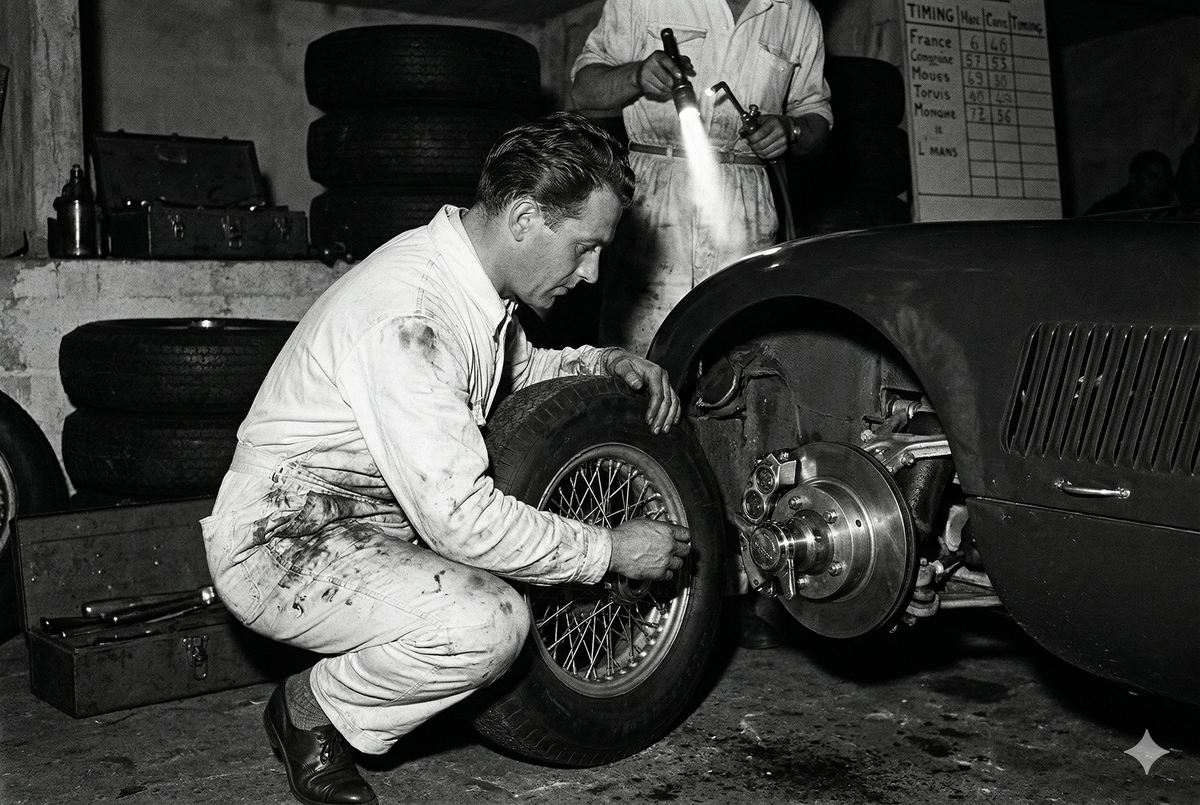
The drum brake's fundamental problem was always thermal, and everyone in motor racing knew it - the friction material heating the drum, the drum expanding away from the shoes, the pedal going progressively softer until, at the end of the Mulsanne Straight at sustained racing speeds, you were essentially pointing a fast car at a corner and hoping. The problem had been tolerated for decades because no credible alternative existed. Then Dunlop found one in the wheel wells of military aircraft, and the history of how brakes work on every car you have ever driven begins in a wartime hangar rather than on any racetrack.
Dunlop's Aviation Division had been developing disc brake systems for aircraft through the late 1940s, solving the specific challenge of stopping aircraft that were growing heavier and faster while landing on runways that were not growing longer. The caliper-and-rotor principle - clamping friction pads against the face of a rotating disc rather than expanding shoes against the interior of a drum - had fundamental thermodynamic advantages. The disc was exposed to airflow, it shed heat rapidly, and critically, it did not expand away from its friction surface under temperature: the harder you braked, the more consistently it worked. By the time Jaguar's competition department began conversations with Dunlop engineers around 1951, the aviation application was already proven. The question was whether it could survive the sustained punishment of a racing car, with its higher unsprung weight considerations and the need for consistent performance across twenty-four consecutive hours at Le Mans.
The development programme that followed was methodical and deliberately secretive. Stirling Moss drove a C-Type fitted with prototype Dunlop discs at the 1952 Mille Miglia - not widely reported at the time, because Jaguar had no interest in advertising the technology to Ferrari or Aston Martin before it was race-ready. Track testing through 1952 revealed that early pad compounds wore through too quickly for endurance use; by early 1953, Dunlop had produced thicker, more durable pads that could survive a full race distance without replacement. The 1953 Le Mans proved the system definitively: three works C-Types equipped with Dunlop discs finished first, second, and fourth, their drivers able to brake consistently deep into corners where competitors on drums were already running wide, their heat-saturated shoes fading with each successive lap.
The competitive advantage was so significant that Jaguar made a deliberate decision to keep it exclusive. Dunlop, under the arrangement, would not supply disc brake technology to any other racing team while Jaguar's programme was active - a clause that left Aston Martin working with Girling to develop their own competing disc system for several seasons while the Coventry cars continued to set the standard. It was industrial protectionism exercised at racing speeds, and it worked.
The transition to road cars was not immediate, which itself reveals something about the conservatism of the industry. Triumph fitted Dunlop discs to the TR3 in 1956 for the front axle, making it among the first volume production cars to offer the technology. Jaguar fitted discs all-round to the XK150 as standard, nearly across the entire range, from 1957 - a decision that transformed the car's usability and effectively ended the drum-era XK's most persistent criticism. By the early 1960s the adoption curve had steepened sharply: any manufacturer still fitting drums to a performance car faced pointed questions in the press, and those questions only grew sharper as road car speeds rose to meet what the tracks had long demonstrated was possible.
Dunlop's parallel work on anti-skid technology - the Maxaret system developed initially for military aircraft in the 1950s - followed a longer road to automotive application, but its eventual descendant, the ABS systems fitted to virtually every car produced today, traces a direct lineage through the same Coventry engineering division. The disc brake story is usually told as a motorsport achievement, which it is, but its fuller significance is safety-engineering at scale: a technology transfer from aviation to racing to road cars that removed one of the most reliably dangerous failure modes from the most ordinary driving situations. The fade that killed drivers on mountain passes and panicked commuters on downhill roads simply stopped being a general-purpose problem after the drum era ended.
What is easy to forget, from a vantage point where discs are as unremarkable as seatbelts, is how contested the transition was and how recently it happened. As late as the mid-1960s, some manufacturers continued fitting drums to production cars not from ignorance but from cost calculation - discs were more expensive to produce, required different pads and fluid, and the warranty implications of a newer technology were taken seriously. The drum era did not end with a single race or a single announcement; it ended with the accumulated weight of evidence from Le Mans, from road tests, and from the hard arithmetic of stopping distances that no amount of engineering optimism could make the drums answer satisfactorily. Dunlop and Jaguar supplied most of that evidence. The rest of the industry eventually stopped arguing with it.