Carl Borgward - Designer and Founder
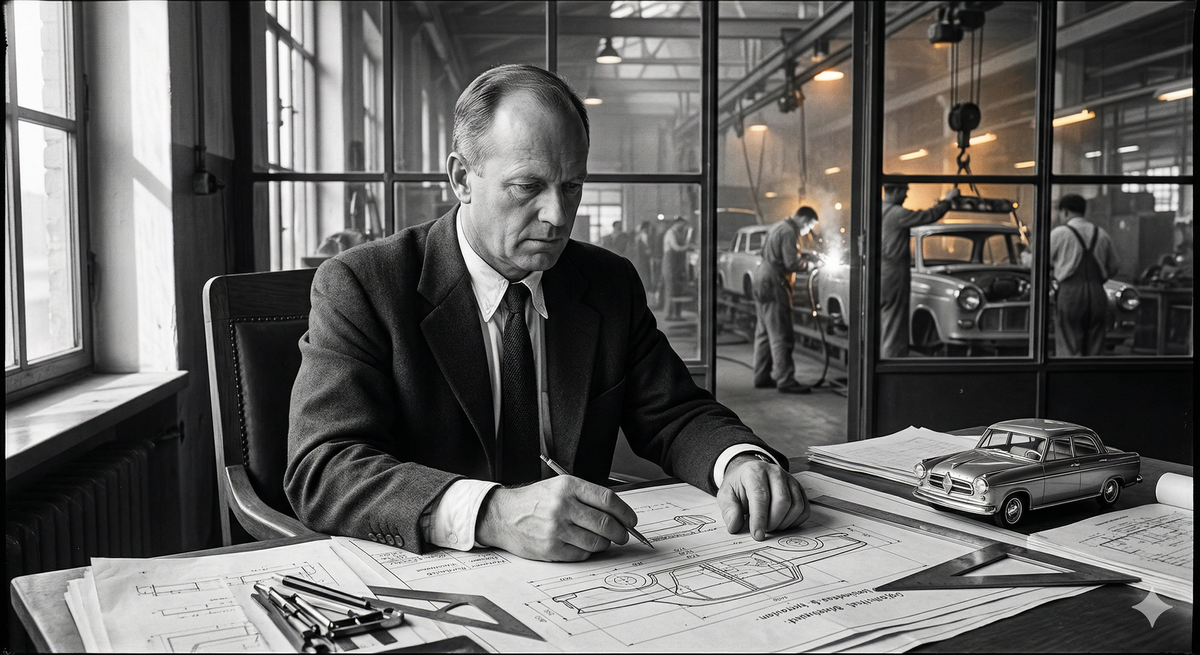
Germany's automotive story is usually told through the survivors - the giants who absorbed everyone else or simply outlasted them. Carl Borgward built something that refused to fit that narrative, and the refusal cost him everything.
Born in 1890 in Hamburg-Altona, the son of a coal merchant, Borgward trained as a locksmith before working his way through an engineering diploma in 1913. He arrived in the automotive world sideways, through radiator and fender manufacturing, joining Bremer Reifen-Industrie after the First World War and eventually taking it over entirely. What followed was not a careful corporate climb but a relentless, improvised expansion driven by one man's compulsion to design and build. His first vehicle, the 1924 Blitzkarren - a three-wheeled, 120cc postal delivery cart - was demonstrated personally by Borgward in the streets of Bremen. He was, from the beginning, his own best salesman and his own worst manager.
The Borgward Group that emerged from those early three-wheelers was structured with a peculiarity that tells you everything about its founder. After the Second World War, faced with post-war steel rationing, Borgward split his operations into three nominally separate companies - Borgward, Goliath, and Lloyd - specifically to qualify for more raw material allocation. It was an audacious bureaucratic maneuver, and it worked. Each brand occupied a distinct market tier: Lloyd's tiny, fabric-bodied Alexander catered to working-class buyers desperate for mobility, the Goliath line bridged into the lower-middle segment, and the Borgward marque itself addressed the aspirational buyer who wanted European proportions with American style. At the group's peak, Borgward was the third-largest automaker in Germany, employing over 20,000 people across its Bremen factories.
The crown jewel was the Isabella, launched in 1954. Borgward himself participated in the detail design of all models, and the Isabella showed what that hands-on involvement could produce - a genuinely elegant car that matched the postwar German customer's appetite for chrome and sweep without tipping into vulgarity. It became one of the most popular premium models in Germany throughout the late 1950s, a fact often forgotten because the story ends badly.
And it ends very badly. Borgward refused to delegate. He was simultaneously sole chief designer, lead engineer, and de facto CFO of an organisation far too large for one person to hold together. When he launched both the flagship P100 - developed at a cost of DM30 million - and other new models in the same period while managing a 20,000-strong workforce, the financial strain became unsurvivable. The group collapsed in 1961 under circumstances that remain disputed to this day: creditors, politicians, and rival manufacturers have all been accused of engineering the bankruptcy for competitive reasons, and Borgward himself maintained until his death in 1963 that the company was solvent when it was forced into liquidation.
The cultural verdict on Carl Borgward is the most fascinating part of his legacy. He was a self-made engineer-entrepreneur in the mold that postwar Germany admired enormously - but the admiration curdled when the collapse arrived, because it arrived so suddenly and with so many workers unemployed. The rehabilitation of his reputation has been gradual and incomplete. A Chinese-backed revival of the Borgward name appeared at the 2015 Geneva Motor Show, trading on brand nostalgia with no real continuity of engineering culture. It was a tribute act, not a resurrection.
What Borgward actually built - across four brands, from postal three-wheelers to the graceful Isabella - was a complete automotive ecosystem assembled by one man's refusal to accept that vision and execution needed to be separated. That stubbornness was both the source of everything that worked and the direct cause of everything that didn't. Few figures in automotive history make the connection between genius and catastrophe quite so legible.