Badge Engineering in Postwar British Cars
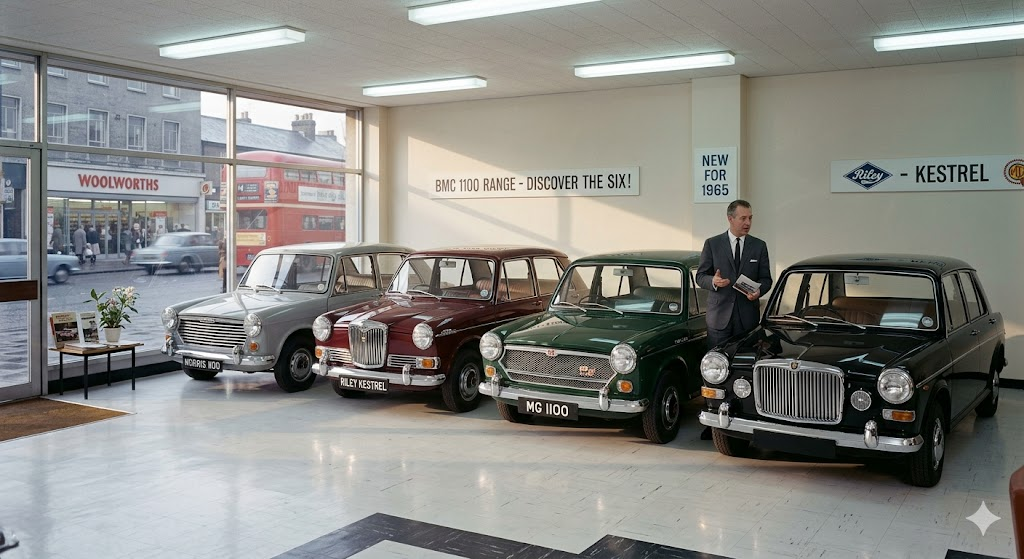
The cruelest thing about badge engineering in postwar Britain is that it worked, right up until the moment it didn't. For two decades, the British Motor Corporation sold essentially the same cars under Austin, Morris, Riley, Wolseley, MG, and Vanden Plas badges, and the public - at least for a while - kept buying them in extraordinary numbers. The ADO16 family, built around the transverse-engined platform that underpinned the Morris 1100, became Britain's bestselling car range through most of the 1960s, commanding a peak UK market share of 14.3 percent in 1965 while wearing six different grilles and half a dozen distinct price tags. The strategy was not dishonest exactly. It was something more complicated: a rational industrial response to an irrational commercial situation, dressed up as choice.
The roots of it lay in the 1952 merger of Austin and Morris to form the British Motor Corporation - a consolidation driven by genuine industrial logic, combining two companies that had spent the preceding decades building parallel dealer networks, parallel model ranges, and parallel engineering departments that largely duplicated each other's work. The merger's first instinct was not to rationalise the brands but to share the platforms beneath them, selling the same car twice through two separate distribution chains. It was cheap, it was pragmatic, and for a manufacturing economy still recovering from wartime disruption and material shortages, it made a kind of sense that only the balance sheet fully appreciated.
What it produced was a taxonomy of managed distinction. The base Austin or Morris variant came plainly trimmed and affordably priced. The Wolseley version added a wood-veneered dashboard, a traditional upright grille with an illuminated badge, and a leather-wrapped steering wheel - the visual language of a more established, dignified brand. Riley went further into sporting territory, with twin carburettors on some models, a different instrument cluster, and the red diamond badge that invoked a competition heritage the cars could no longer honestly claim. Vanden Plas sat at the apex, offering hand-finished interiors and rear picnic tables to buyers who wanted something that felt chauffeur-adjacent without actually requiring one. The engineering underneath was, in all cases, identical.
The Riley Elf and Wolseley Hornet - both of them Mini derivatives launched in 1961 - represent the concept at its most explicitly theatrical. Alec Issigonis's masterpiece of packaging efficiency had its tail grafted with a proper boot, its nose resculpted to accommodate a traditional upright grille, and its dashboard refitted in polished walnut veneer, all in order to create the impression of two separate, heritage-rich motor cars from what was unambiguously a single small saloon. The transformation was not without charm - the Hornet and Elf possessed a certain Edwardian absurdity that enthusiasts still find endearing - but as an engineering proposition it was essentially costume drama, and customers with any curiosity about what lay beneath the costumes were not deceived for long.
The genuine successes of the approach were real, and deserve acknowledgement. Shared platforms reduced development costs that postwar Britain's car industry could not have easily absorbed otherwise. The ADO16's Hydrolastic interconnected suspension system - one of Issigonis's most inventive solutions, linking front and rear fluid displacers to give a remarkably composed ride from a compact package - was rolled out across the entire badge-engineered family, meaning that engineering innovation reached more buyers more quickly than a fragmented model range could have managed. The MG 1100 was, by any honest measure, a better daily driver than most purely sporting alternatives of its era, precisely because it combined the platform's intrinsic competence with sportier tuning and a lower price than an MGB.
The drawbacks accumulated slowly and then all at once. The problem was not that customers resented sharing a platform - most never knew or cared. The problem was market cannibalism: Austin and Morris dealers were selling the same cars in competition with each other, depressing residual values across the entire range and diluting the brand equity of every marque simultaneously. Riley, a name that genuinely deserved better, was reduced by the late 1960s to being a trim level with a distinctive grille, its competition heritage long since reduced to a marketing footnote. The 1969 Riley Kestrel - an 1100/1300 with walnut trim - was the last car to wear the badge that had won at Le Mans in 1934. It went out not with a race but with a brochure.
The Ryder Report of 1975, commissioned as British Leyland teetered on the edge of nationalisation, identified badge engineering directly as a root cause of the company's structural weakness, recommending that the individual marque identities be dissolved in favour of a unified Leyland brand. The recommendation was implemented, briefly and disastrously, producing cars with Leyland roundels instead of Austin or Morris badges that pleased nobody and sold to almost no-one. The irony was complete: the strategy designed to preserve brand heritage had eroded it so thoroughly that when the brands were finally removed, almost nothing of value went with them.
What badge engineering in postwar Britain ultimately reveals is the industrial cost of sentimentality - the price paid for maintaining the names of Riley, Wolseley, and Singer long past the point where the engineering behind them could justify the claims those names implied. The names were worth keeping. The will to back them with genuinely differentiated products was not there. And so the marques became hollow, the badges became punchlines, and the industry that had once led the world in both volume and variety arrived at the 1980s carrying the weight of brands it had spent thirty years quietly emptying of meaning. It is one of the more instructive cautionary tales in automotive history, and one that the industry keeps having to relearn.