1959 Porsche 356 A 1600 Coupé: Where Porsche Found Its Voice
The 1959 Porsche 356 A 1600 Coupé by Reutter is where Porsche stopped improvising and started building a legacy that endures to this day.
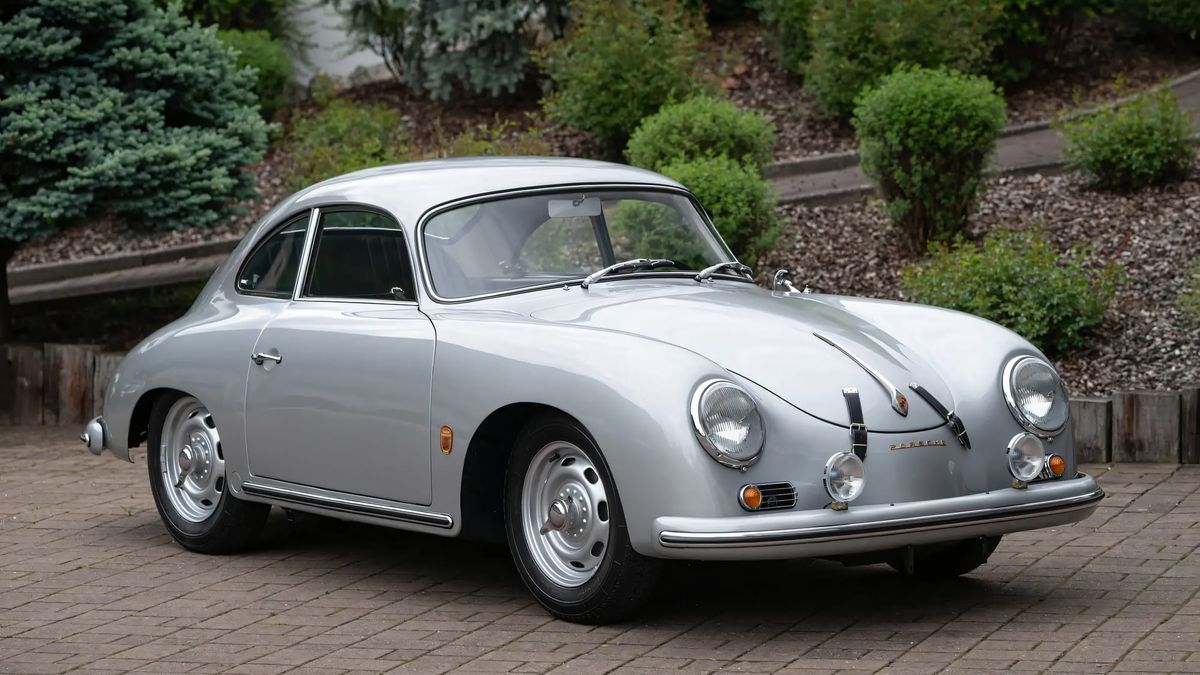
When the decision was made to replace the flat, divided windscreen of the original 356 with a single continuous curve of glass, it wasn't simply a styling exercise. It was a diagnosis. The split screen had been perfectly honest about what the first 356 was: a thin-budget sports car assembled from reclaimed Volkswagen components, built by a fledgling company in a borrowed factory, willing itself into existence through sheer engineering conviction. The A-suffix that arrived at Frankfurt in September 1955 said something different - that the improv was over, and that Porsche now knew exactly what it wanted to be. The 356 A 1600 Coupé by Reutter is the most complete expression of that conviction.
The "by Reutter" suffix is not incidental. Stuttgarter Karosseriewerk Reutter & Co., based in Zuffenhausen, had been Porsche's essential partner since the early Stuttgart production years - the firm that possessed both the tooling and the craftwork to translate Ferdinand Porsche's aerodynamic ambitions into hand-formed steel reality. Porsche didn't merely contract Reutter to stamp out bodies; they relied on them to exist as a car company at all. The relationship was so foundational that Porsche eventually absorbed the Reutter factory entirely, turning it into Werk 2, where 356 bodies continued their journey down the line. So when a Coupé wears that name, it carries with it the full weight of this industrial symbiosis - two companies bound together by necessity and refined into something more permanent by talent.
Within the 356 A family, the Coupé occupies a deliberately unglamorous but deeply rational position. Porsche gave buyers three main body choices: the Speedster - stripped, theatrical, American-market bait - the Cabriolet, which offered open-air touring with proper weather equipment, and the Coupé, which got out of the way of the others and simply worked. Buyers responded accordingly: nearly 6,000 T1 Coupés were produced in the first run, practically doubling the combined output of the Cabriolet and Speedster, and the subsequent T2 variant added roughly another 7,200 cars. The Speedster gets the posters; the Coupé built the company.
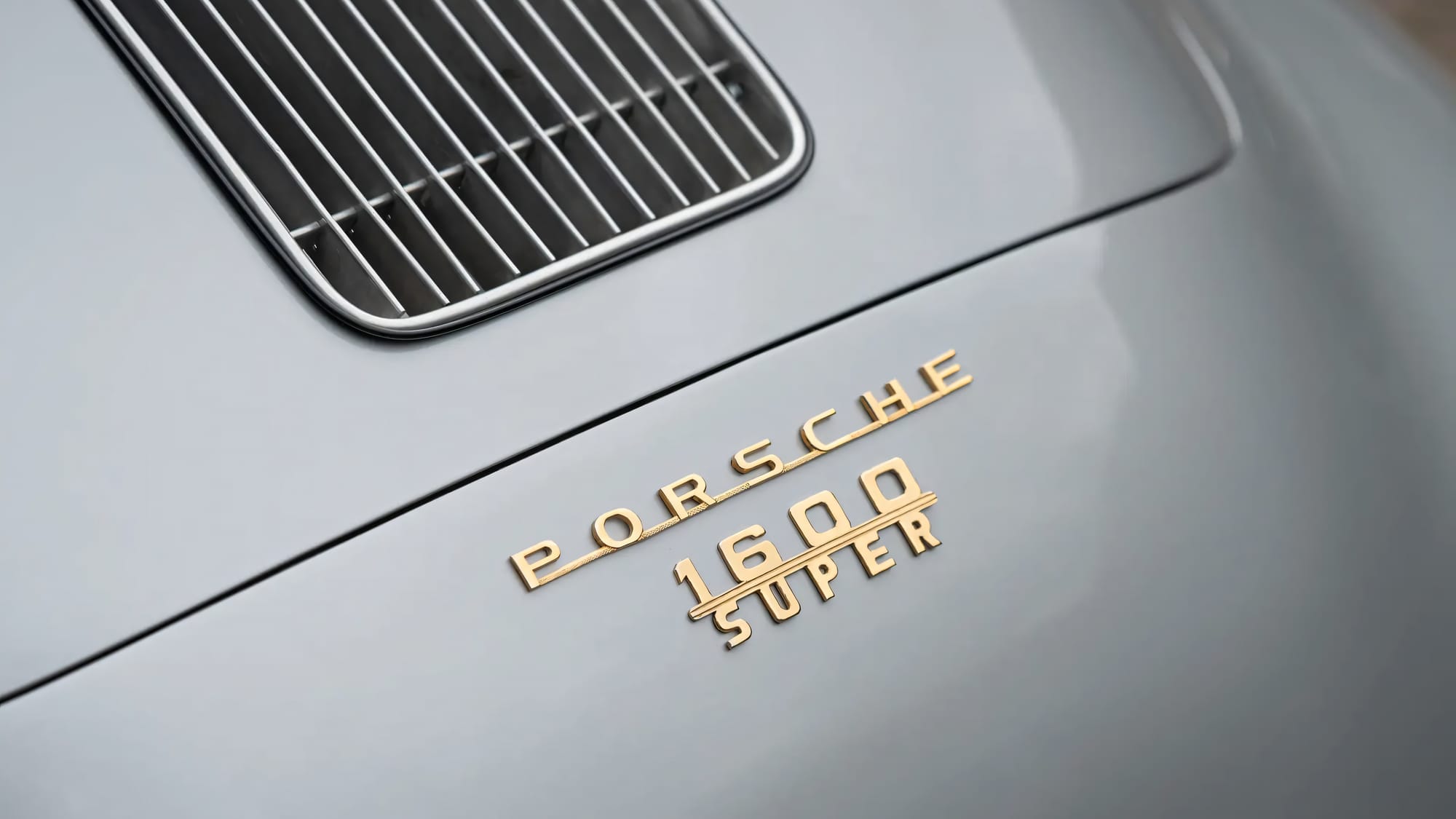
The 1600 designation refers to the enlarged 1,582cc displacement of the air-cooled flat-four engine, a meaningful step up from the 1,300cc units that had preceded it. The base 1600 produced 60bhp at 4,500rpm with torque of 81lb ft - enough for a 103mph top speed and a 0–60 time of 14.1 seconds in a car weighing considerably less than a tonne. Those numbers read slowly by modern standards, but the 356 A was never a brute-force proposition. The more interesting specification is the Type 616/2 Super engine - same architecture, but breathing harder through two Zenith downdraft carburettors (replacing the earlier Solex units on T2 cars), raising output to 75bhp and sharpening the car's responses meaningfully without altering its fundamental character. The Super occupies the sweet spot: engaging without the exotic temperament of the four-cam Carrera, maintainable without the specialist knowledge that unit demands.
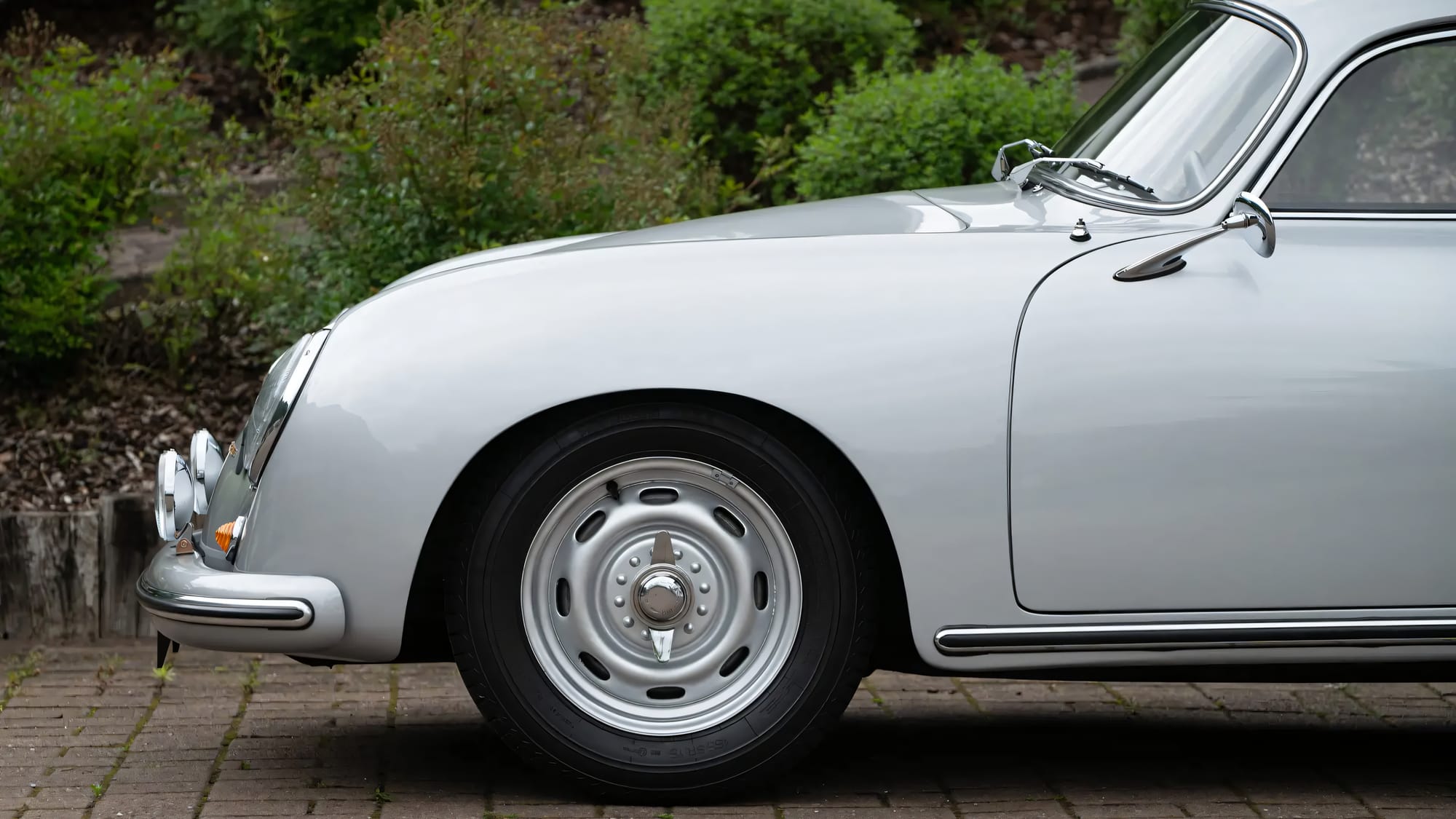
The suspension revisions that came with the 356 A were, if anything, more significant than the engine upgrade. Porsche's experimental department - the Versuchsabteilung - spent considerable effort recalibrating the torsion-bar setup, softening the springs by removing leaves while simultaneously fitting stiffer dampers. The goal was compatibility with the new generation of wider, lower-profile 15-inch tyres that the period's improving rubber technology made possible. This recalibration addressed one of the most persistent criticisms of the earlier cars: they were too nervous over broken surfaces and too reluctant to steer from their natural line. The A-series car found a more communicative balance, asking less of the driver in terms of raw correction while offering more in return as driving tool.
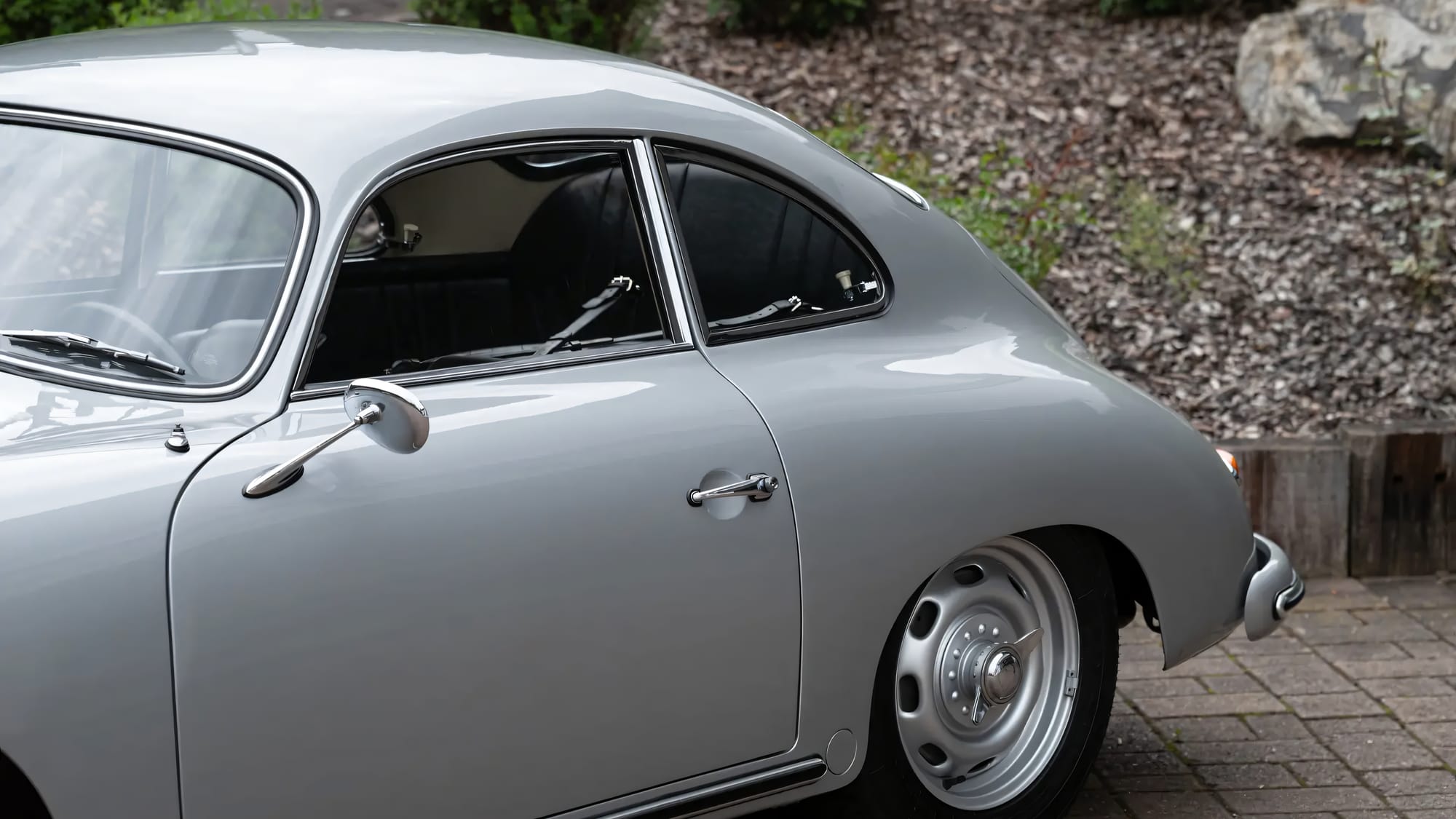
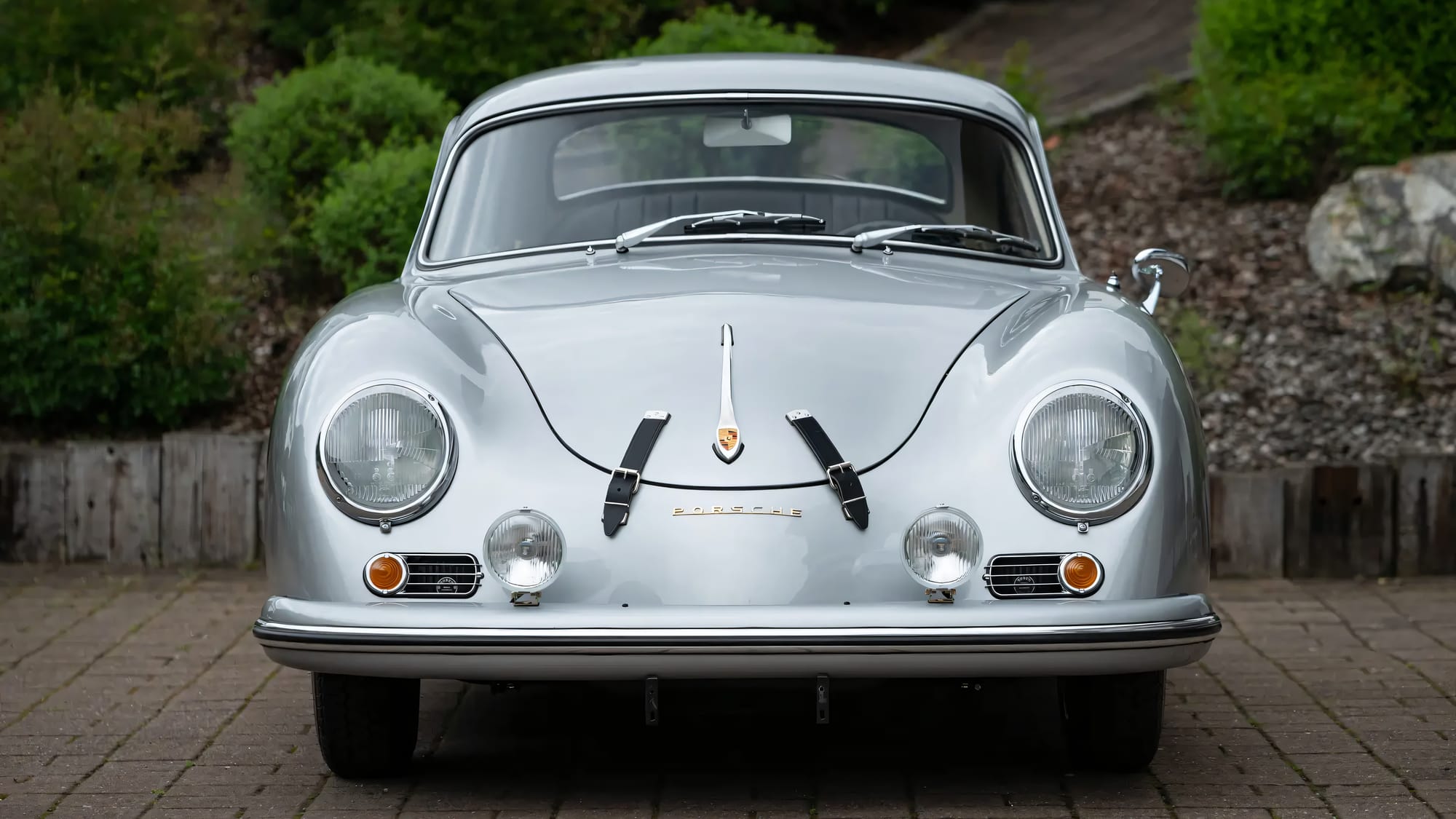
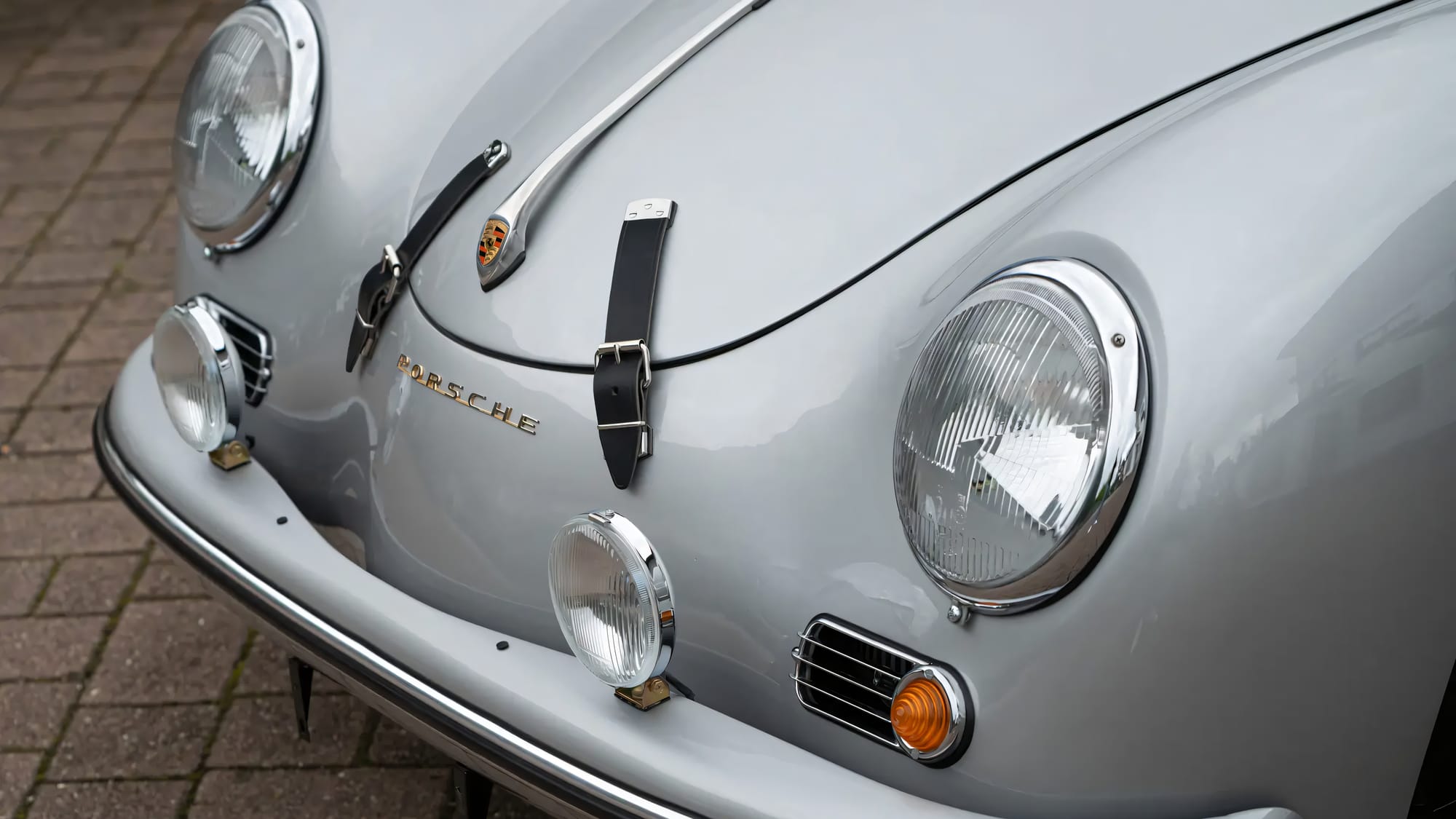
Aesthetically, the 356 A Coupé exists in a register that is difficult to describe without resorting to the word "perfect" - which should always be treated as a warning sign - so let's say instead that it is extremely resolved. The full-coverage fenders, the smoothly faired headlamps, the near-total absence of decoration: none of it requires justification because it arrived fully formed from aerodynamic logic rather than stylistic whim. The curved windshield that announced the A-series integrated into this envelope without disruption; it improved forward visibility and weather sealing while strengthening the visual flow from bonnet to roofline in a way the split screen could never manage. A Coupé in Silver Metallic against black leather is among the more elegant factory combinations available - cool rather than precious, purposeful rather than showy. The Rudge centre-lock wheels, occasionally fitted as a period option, add a quietly motorsport-aware punctuation mark to the exterior without shouting about it.
Driving one honestly is an exercise in recalibrating expectations, and that's not a criticism in disguise - it's the specific pleasure the car offers. The steering is light and surprisingly quick, the gearbox short-throw and cooperative once warm. The engine, mounted behind the rear axle in the fashion that Volkswagen engineering had made familiar, delivers its power with an almost conversational evenness up to the mid-range, then sharpens noticeably as the Zenith carburettors breathe more freely above 3,500rpm. The sound at full song - that particular mechanical bark of a small, hard-worked flat-four - is one of the more satisfying noises in the classic car catalogue, part Beetle ancestry, entirely Porsche in delivery. Weight transfer in corners is rear-biased and requires respect; push too hard and the tail steps out with a willingness that was very much of its era. The correct response is smooth, not frantic - which teaches you something about the car's personality quite quickly.
Strengths emerge with use. The structural integrity of the Reutter-built steel body is notable - these cars have survived decades of use and abuse with fewer rot problems than many contemporaries. The mechanical simplicity of the air-cooled flat-four means that proper maintenance requires competence rather than wizardry. The Coupé's closed body gives it practical usability that the Speedster enthusiasts quietly envy when it rains, and the modest dimensions make it manageable in situations where something wider would become a liability. And the Super engine, in particular, strikes a balance between accessible performance and period-correct character that more powerful variants sometimes sacrifice.
The compromises are real and should be named. Interior space is, to use the most generous available word, compact. Two adults fit comfortably; luggage is a negotiation. The swing-axle rear suspension, for all its refinement in the A-series, remains a period solution to a period problem - it imposes a camber penalty under hard cornering that a more modern geometry would not. Cabin noise at motorway speeds is significant; the engine is rear-mounted and the cabin thin-walled, and these are facts no amount of enthusiasm can alter. Heating is unreliable and ventilation modest. These are not reasons not to own one; they are reasons to understand what you're signing on for.
Culturally, the 356 A 1600 Coupé's significance operates at a level that exceeds its statistics. It was the car that proved Porsche could sustain a product line rather than simply produce a romantic prototype. The class victory at Le Mans in 1951 had planted the flag; the 356 A, with its broader model range and its serious engineering revision, consolidated the territory. Max Hoffman, the importer who had the instinct to push these cars into the American market, understood something essential: that there was a customer who wanted more than raw speed, who wanted intelligence made metal, and that this car delivered it at a price that made sense. The American appetite for the 356 A Coupé shaped the model's production priorities - the Speedster was a Hoffman idea, and the Coupé's dominance of sales figures tells you which proposition actually held.
Critical reception in period was admiring with caveats that align precisely with what modern owners report. Road & Track and Sports Car Illustrated tested the 356 A thoroughly and found performance that was modest by the standards of the British competition but distinguished by its consistency and refinement. The car did nothing badly, which in the mid-1950s sports car market was genuinely unusual. The swing axle behaviour was noted; so was the limited luggage space. What the testers kept returning to, in different words, was the quality of the experience relative to the asking price - the sense that the car had been built by people who cared about the driver rather than by people who cared about the specification sheet.
The Reutter coachwork eventually gave way to Porsche's own production facility after the factory acquisition, and the 356 A itself was superseded by the B in 1959, which brought a higher headlight position, revised bumpers, and the usual incremental improvements of a model range finding its maturity. What the A had established could not be revised away: a design and engineering language so coherent that Porsche has spent the seven decades since attempting, with varying success, to maintain the same conversation. The 911, in its original configuration, was this car's direct heir - air-cooled, rear-engined, made lighter and faster but not reconsidered. The 356 A 1600 Coupé is where Porsche stopped improvising and started building an argument it has been refining ever since.